
The decision made by the government in England to begin a phased reopening of schools from the 1st June 2020 has concerned school leaders and councils, with parents equally worried about the safety of their children. Our Special Interest Group for Wellbeing and Inclusion – representing a range of interdisciplinary perspectives – discussed some of the key issues surrounding the transition back to school, which led us to produce this three-part blog series.
Each blog offers a range of perspectives from academic staff and doctoral students from Cambridge University, drawing on relevant research and theories in our respective fields, to disentangle what the return to school means for teachers, learners and schools as a whole, not only in England, but worldwide.
Part 3 features two different perspectives from education: peace education and considering children’s wellbeing in settings of crisis and poverty (Nomisha Kurian) and collaborative arts education (Andrie Savva). Each contribution offers a response to the following questions:
‘What might be the key considerations for educators when supporting children to transition back to school following Covid? And how might schools best support children in a post-Covid lockdown world?’
The questions we face
Helping children feel safe and hopeful again: rebuilding peaceful schools
Nomisha Kurian, PhD candidate at the Research for Equitable Access and Learning Centre, Faculty of Education, University of Cambridge, researching child wellbeing in settings of violence, crisis and poverty
‘Peace’ is a bit like ‘wellbeing’. Most people agree that it matters, but few find it easy to define. To help refine our thinking, we can draw on a typology that has guided generations of peacebuilders. ‘Negative peace’ is the absence of violence (no riots on your street, nobody breaking into your home). ‘Positive peace’ is the active presence of conditions helping you flourish (you earn fair wages, you trust your government).
Both kinds of peace complement each other. For example, if a fight erupts in a classroom, a teacher will first try to stop it (negative peace). Later – after things have cooled down – she might devise a plan to prevent fights erupting in her classroom in the future and promote warm, supportive relationships amongst the children in the long-term (positive peace). If we approach COVID-19 from this holistic lens, then stopping the spread of the virus in school does not seem like enough. To make schools emotionally as well as physically safe, we need to build inclusive and compassionate cultures that address complex threats to wellbeing during COVID-19 and beyond.
For example, we could promote ‘positive peace’ through anti-bullying policies that are sensitive to the new vulnerabilities of some children. As early as the first days of February, a 16-year-old Asian-American boy was attacked in school because other students thought his ethnicity gave him coronavirus. As public awareness about COVID-19 rose, so did such incidents, with children as young as nine targeted for their Asian heritage. This pandemic has spawned broader patterns of certain groups being treated with suspicion and revulsion. The bullying of people of Asian origin has escalated to the point where the United Nations Secretary-General Antonio Guterres has said that the ‘virus of hate’ is just as destructive as the coronavirus.
When fear and panic trigger new forms of violence, how can schools respond? As Ros and Tania explore in their previous post, feeling a sense of belonging and feeling cared-for are core human needs. School staff might thus need to work harder than ever to ensure that all children feel safe and welcome. This could mean explicitly teaching the dangers of discrimination; explaining how the crisis transcends national borders and demands global solidarity; and emphasising how no child deserves to be bullied based on how they look or where they come from. Older pupils might be encouraged to practice critical thinking by discussing how prejudice undermines their collective wellbeing as a school community. Such steps could promote long-term peace beyond the pandemic.

Weaving new narratives of solidarity in crisis might also encourage unity. Accounts of schools’ recoveries from other disasters can inspire us. Japanese teachers who rebuilt their school post an earthquake and a tsunami have shared how they transformed their school gym into a community support centre and offered temporary housing on the school grounds. Their school became an intergenerational hub where people from the wider community found shelter and solace. We might also draw on insights from school-research partnerships designed in the aftermath of the 2010-11 Canterbury earthquakes in New Zealand. Children used symbolic play to think about hope and resilience, repairing a torn ‘cloth of dreams’ in a school play and adding ‘new dreams’. They came up with a range of ingredients: ‘three bales of belief’ ‘cups of love’ ‘handfuls of giggles’ and ‘a teaspoon of light from the darkest tunnel’. Might we rebuild peaceful schools by trusting in the imagination and creativity of our children and guiding them to construct narratives of hope in the face of crisis?
In the same study, children also became hopeful when encouraged to transcend the particular (‘my story’), recognise the collective (‘our story’) and articulate larger conceptual implications (‘what does our story tell us about who we are?’). For example, one activity asked them to picture themselves as a grandparent telling their grandchildren about the earthquakes. Collective storytelling in crisis helped the children regain a sense of purpose and meaning as a community. Similarly, when they made time capsules or built living gardens and mosaics of their experiences, they found comfort in the idea of legacy: becoming part of something bigger than themselves, contributing to the collective memory of a society, and preserving the stories of themselves, their families and their schools for future generations.
I have highlighted these stories to wonder out loud if we could use these powerful tools to build positive peace. We are living through a time when fear might fragment our society along the dangerous fault lines of prejudice and division. Embracing solidarity and helping our children feel safe and hopeful again seems vital. Perhaps our priority can be to build inclusive, compassionate and truly united school communities. Not just for now, not just until the vaccine is found, but for the long haul.
Art and collaboration as key factors in education in a post-Covid lockdown world
Andrie Savva, PhD student at the Faculty of Education, Cambridge University

From my axiological perspective as a former primary-school teacher and a current PhD student, I find two factors having immense importance in shaping practice and research: collaboration and art. Art’s integration in education and throughout the curriculum presupposes a pedagogical stance that prioritises a holistic approach over fragmentation and the cross-fertilisation among disciplines and subject area.[i] This viewpoint highlights the wholesome development of the ‘person’ and supports an amalgam of ideas, concepts and skills over the compartmentalisation of knowledge. Although relevant research has identified areas of caution, proponents of this school of thought argue for advances in the cognitive, emotional and social terrain. As such, this approach empowers students to better understand the world they live in and equips them with knowledge and skills applicable in authentic, real-life situations.
Technological advances have pluralised and complexified everyday life and the educational practice. Students need the aptitude to explore in different ways and contexts. They are invited to engage with and even produce various ‘alternative texts’, expanding to innovative hybrid forms of artwork that imaginatively enmesh various modes of representation and communication, such as the verbal, the visual, the auditory, the spatial, the gestural, the tactile, the kinaesthetic. This perspective supports diverse and various ways of inquiry, critical and creative thinking, problem-solving, communication and expression. During this process, students could work alone, collaborate with one-another and take under consideration a harmonious co-existence with their current environment. The ‘important other’ becomes a valued ally; peers, teachers, carers, knowledgeable experts from various fields may contribute their insights, experiences, and expertise. The physical surroundings may provide essential necessities, as well as inspire, broaden experience and expand the traditional educational notion of the ‘school context’.
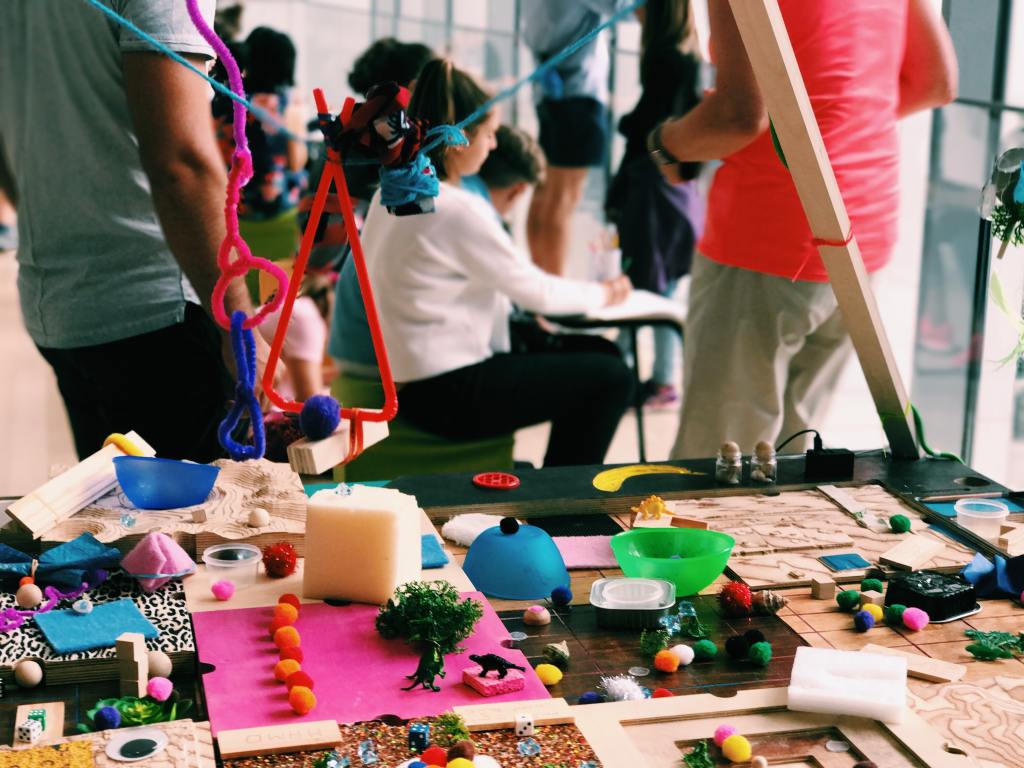
Art and collaboration, as two pillars of the sociocultural and educational context, are transformed during lockdown. Technology has made possible for virtual cultural experiences. On-line art-exhibitions and artistic performances, authors reading their books and illustrators sharing their artistic process are examples of how art and collaboration can be approached during lock-down. Creative engagement with art may incorporate any virtual context, such as the one provided by a virtual museum or a virtual stroll in a natural environment. Response may be expressed through various materials and in different ways. Technology can expand the traditional ‘on-site’ walk and engagement, providing with diverse ways of communication. As such, technology may pluralise experience for those with access.
In this scope, traditional beliefs about the boundaries and nature of literacy are transcended. Literacy is no longer considered as monolithic, rather it is considered as a multifaceted notion. Multiliteracies as an encompassing umbrella-concept, although discussed more than 20 years ago by the New London Group,[ii] is more contemporary than ever in the current context. The Covid-19 situation underlined the necessity to develop intrapersonal and interpersonal capabilities and acquire dexterities and skills to engage with a new educational, social and cultural practice and reality. What’s more, it highlighted the importance of balance between face-to-face and technologically mediated interaction, as a fundamental aspect of humanity.
In a post-lockdown context, art and collaboration should acquire primary role in education. Maintaining an arts-rich foundation in education practice is a valued way of enhancing transition, communication and collaboration. Engagement with various forms of art and various materials (traditional and diverse), and expression in multiple ways are necessary to empower choice and enrich the visual, haptic, audio, and proprioceptic experience, and thus the learning process. At the same time, enhancing this natural predisposition empowers the sense of mutuality and belonging through artful and meaningful participation. Transitioning from a heavy-technologically mediated interaction, social distance and isolation, only highlights the need for a different form of interaction that is intellectually, emotionally and interpersonally stimulating.
The experience of the Covid-induced lockdown is a novel one in contemporary society. Conceiving art and collaboration as essential parts of human nature, both being paramount for affect, satisfaction, motivation and survival, could provide the bedrock for the post-lockdown educational context. Such an approach steps on the philosophical structures of our past and could yield the pathway of moving forward in the post-lockdown era. Enabling the aesthetic value of art interwoven with its social potential in the educational daily life, should provide for meaningful and ‘poetic’ experience in our new reality.
[i] Bresler, L. (2007). International Handbook of Research in Arts Education. (Vol. 16). Dordrecht, NL: Springer.
[ii] New London Group. (1996). A pedagogy of multiliteracies: Designing social futures. 66(1), 60–92.
 Cambridge Wellbeing & Inclusion SIG