
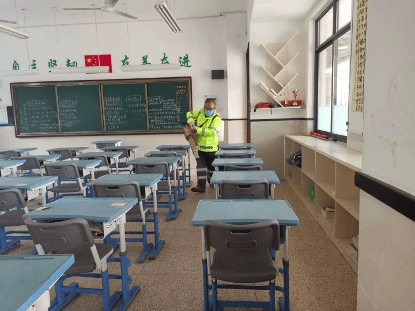
Staff preparing for the reopening of a school
Wanying Zhou, PhD Student in Psychology and Education & Mental Health Counsellor (Hangzhou, China)
Covid-19 caught the world off-guard. At the time of writing, it has been five months since the outbreak, and, as one of the first countries to face this epidemic, China has taken the lead in confronting the challenges presented and adapting to the post-pandemic world. There is no doubt that these five months have changed many aspects of Chinese people’s lives, no matter their age groups, social status, or geographical locations. As a psychology and education researcher, as well as a counselling practitioner who has in-depth experience of this outbreak in China, I hope my authentic observations may be useful to those living in countries that have not yet experienced the ‘post-pandemic’ period, specifically on the topic how the transition back to schools can be managed.
Although China took a series of precautions concerning the reopening of schools, some unforeseen consequences have occurred. These include mental health issues and conflict between families and schools. In my opinion, Covid-19 does not bring new problems to education, but rather, unearths and aggravates existing issues.
Following the outbreak of Covid-19 in China, all sectors of society have been called upon to contribute to overcoming this unmitigated challenge. In particular, China has made use of its growing high-tech capabilities. This can be seen clearly in the education sector where DingTalk – a communication app from Alibaba initially designed for workplaces – has changed its platform to accommodate student use. As the new semester began in February, most Chinese schools, especially in developed coastal cities, reacted quickly with help of DingTalk. According to the Xinhua news network, 3.5 million teachers from 140,000 schools that teach 120 million students (around 50% of Chinese students) used this live-streaming app to maintain students’ education during lockdown. Moreover, Alibaba invented an QR code system using big data to help determine whether one person could move around unrestrictedly or should self-quarantine. This health code app raises concerns over privacy, but it is helping China to transfer back to normal life easily.
In terms of how the government has reacted to the crisis, the Chinese Ministry of Education (MoE) has been cautious about how and when to resume schooling. In early March, several provinces with zero confirmed cases – mainly in central and western China – set a time frame for the reopening schools. Generally, all provinces have adopted the so-called “off-peak” policy and have prioritised the return to school of third-year middle schoolers and third-year high schoolers, who are due to take important national exams this summer. The Chinese MoE has also emphasised that schools need to consider their own circumstances in implementing the ‘one school, one policy’ approach.
Chinese students’ mental wellbeing during the transition back to school
Through my work as a counselling volunteer in a middle school, important issues pertaining to the mental wellbeing of Chinese young people have been highlighted. Before I went into the schools, I assumed that the students who would need help after lockdown would be the ones who were most afraid of the disease, or felt most uncomfortable during lockdown. Given this, I prepared myself to handle questions on “fear of death,” “fear of the disease,” and so on. However, to my surprise those students who had been sent to me or voluntarily came to my office showed no interest in talking about these topics. Rather than talking about their feelings about Covid-19 or life during lockdown, the problems students exhibited followed other patterns. These can broadly be divided into two groups.
The first group, like Professor Tamsin Ford mentioned in a previous blog, relates to students who have pre-existing mental health problems or who perennially struggle with school life. The majority of this group are under medication or seeing doctors. The second group has more practical problems. For example, they came to me with questions, such as “I have been trying so hard, but my score has not improved”; “I feel useless”; “I don’t get on with my classmates”; “my parents give me too much pressure” or “my parents give me too little pressure.” Interestingly, the majority of the topics can be explained by Self-Determination Theory (SDT); discussed in a previous blog by Dr McLellan and Tania Clarke. According to SDT, three core needs (competence, autonomy, and relatedness) should be met to help students feel well. Most likely, the three-month lockdown and the time spent alone with their parents has given these students pause for introspection and consideration of their underlying ‘needs’ that are unfulfilled. Whereas previously students would have been preoccupied with school life, and not had time to reflect. The post-pandemic situation is like a mirror that reflects the fact that if we keep ignoring the basic needs of young people, numerous undesirable outcomes are inevitable.
Family-school conflicts
In addition, the lockdown has also caused many parent-child relationships to deteriorate and has caused family-school conflicts. Knowing that students would not be able to focus well at home, teachers intentionally gave students more homework to make them spend more time on their studies. To achieve this goal, parents needed to cooperate with teachers to help their children with homework and to submit everyday homework online. However, with the unhealthy lifestyle evident during the lockdown, students were often unable to finish their homework during the daytime. So, when parents get back home and realised that their children hadn’t finished their homework for the day, big fights followed. Students felt that their parents suffocated them, whereas parents were angry about their children lacking self-discipline. Consequently, some parents started to blame teachers for giving too much homework and having unrealistic expectations. Many parents felt that they were being made responsible for teachers’ work. As a result, family-school conflicts have arisen. Those schools which will reopen soon could also consider helping students to ease the tension with their families and prepare for the potential complaints from parents.
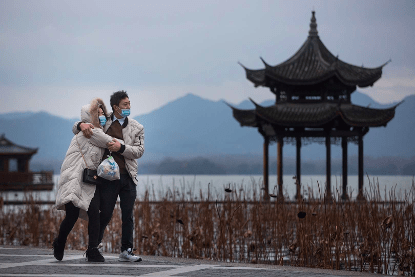
A famous tourist resort (the West Lake) during the lockdown
Students’ body clocks
Finally, unhealthy body clock that students developed during lock down is a typical issue that schools faced when students returned. The period of lockdown was for some students the first time they planned their day and homework by themselves without the explicit guidance of teachers and parents. Indeed, as many parents needed to work during the daytime, students were often expected to take online classes and do homework without supervision. However, most students lack both a strategy to make a feasible schedule and the ability to follow a schedule without support. With no strict timetable for their day’s activities, lots of students developed unhealthy body clocks where they slept late in the daytime and stayed awake during the night. This unhealthy life routine inevitably impedes re-adjustment to school life.
Even the youngest Chinese learners feel the effects of lockdown
Rosie Brown, Primary Years Programme Teacher, currently teaching aged 5-7 (Chengdu, China)
As a kindergarten teacher in Chengdu, I have experienced first-hand how this pandemic has affected some of the youngest learners in China. Many of the observations made by Wanying rang true for my experiences, with some subtle differences. Most notably, unlike junior, middle and high schools, Kindergartens were not able to move their teaching online according to government regulations. This meant a lot of responsibility and pressure was placed upon parents, grandparents and ‘ayis’ (nannies) to ensure children kept up with their studies at home. Schools found creative ways to provide opportunities for learning, for instance sharing videos and at-home activities on the popular platform WeChat, but coming back to school in June revealed a noticeable rift between those children who had clearly been continuing with some sort of educational normalcy, and those who had totally abandoned their studies. This was especially evident in their English language production. There are many bilingual kindergartens in China which aim to provide an immersive English environment for students, and parents are willing to pay a premium for a kindergarten with a foreign teacher. Four months outside of this immersive context showed me just how significant this learning environment is for the acquisition of English in young learners.
The importance of a routine for young learners
Like Wanying, I also observed that children struggled a little to adjust back to the school timetable, although the issues faced by younger students were different. It seems that my students maintained a relatively similar sleep schedule (unlike Wanying’s teenage students), but their eating and exercise habits changed drastically whilst at home. During lockdown many children were free to eat what they wanted, when they wanted and seldom left their apartments (here in urban china it is incredibly rare to have a yard or a garden) so many went days – or even weeks –without any exercise at all. A return to school meant a return to a strict schedule, including PE classes and twice daily outdoor play, and a return to strict meal and snack times with non-negotiable measured portions. My students eat breakfast, lunch and dinner at school, as well as a morning and afternoon snack. For some this meant feeling hungry throughout the day having been spoilt with treats by grandparents and ayis at home, whilst on the other end of the spectrum, I had students saying that they were too full to finish, or complaining that they didn’t like the food, speaking wistfully of the array of options available at home.
If a similar lockdown were to happen again (which isn’t outside the realm of possibility with a second wave predicted in some countries), I would encourage parents to try and mimic the school day as much as possible at home.
Even if the lessons themselves can’t be replicated, it is a good idea to maintain some semblance of a routine. This includes finding opportunities for exercise throughout the day and keeping children on a relatively structured mealtime schedule to ease the transition back into a non-negotiable school timetable.
Routine is vital to supporting young children’s long-term physical and mental wellbeing. Ensuring that young children are getting a balance at home, and following some sort of timetable even during lockdown, will surely support children’s holistic socio-emotional wellbeing… which, at such an unprecedented time, is more important than being able to count to 10 in multiple languages!
Photo credits: Wanying Zhou & Jerry Wang, Unsplash (order of appearance)
 Cambridge Wellbeing & Inclusion SIG