
By Helen Clare, Senior Yoga Teacher, PGCE, BA Hons
Introduction
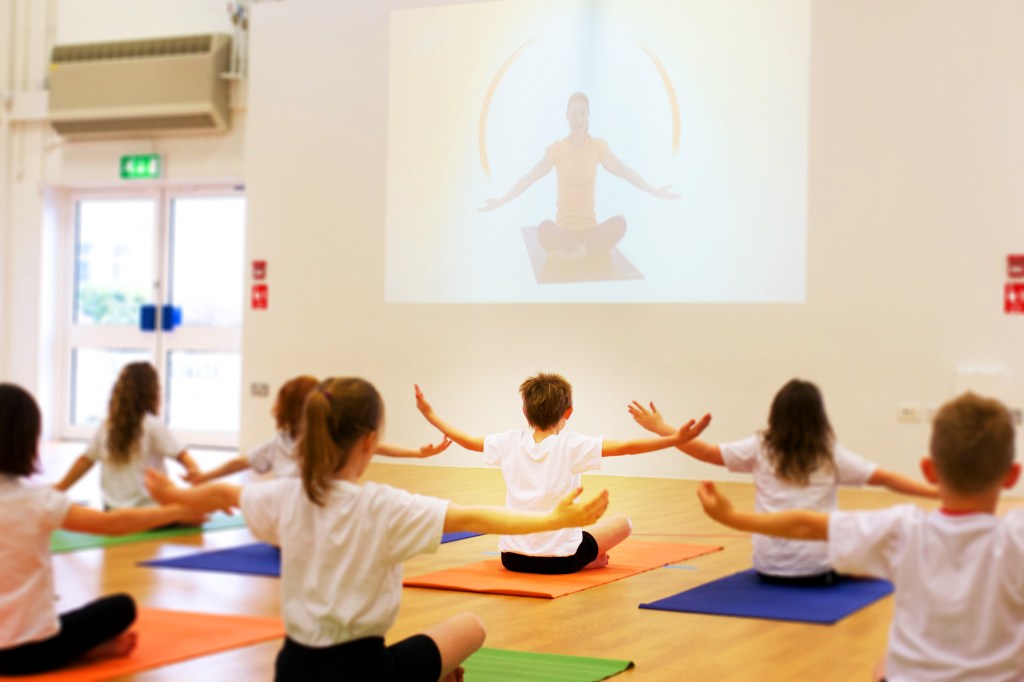
On Thursday 19th November 2020, members of our Wellbeing and Inclusion Special Interest Group (University of Cambridge) met online to engage in a session led by Helen Clare, a Senior Yoga Teacher and Primary School Educationalist. Helen’s session was entitled ‘What is yoga – and how can it raise well-being in schools?’ Following a warm welcome from Fiona Peacock, Helen skilfully guided us through a range of Yoga poses on zoom, enabling us to experience an embodied sense of breathing and mindful movement.
Helen adeptly described her 3 Pillar Approach to Wellbeing in the learning environment, sharing a range of examples from her experience teaching Yoga mindfully in Primary schools. Helen also discussed research from a study of Yoga in the classroom carried out in Colorado. Helen’s stance is that when children are relaxed, present and attentive they are in the optimal place to maximise learning. As an educationalist she considers mindful Yoga practice can enhance wellbeing and learning potential in a school setting.
Her presentation was followed by a rich question and answer session. Questions explored considered the attitude towards Yoga as an Eastern based practice in Faith based schools, inclusion and special needs participation in Yoga, research studies, and the necessary training required by teachers to offer Yoga in the classroom.
Helen has provided a summary for the Blog, drawing on her expertise as both educator and Yoga teacher. She highlights thought-provoking issues, prompting further reflection and debate on the quest for whole school wellbeing initiatives.
By Esther Hunt, Affiliated Lecturer, Child and Adolescent Psychotherapeutic Counselling, Fellow of the Higher Education Academy, Faculty Of Education Cambridge University
The 3 pillar approach to well-being
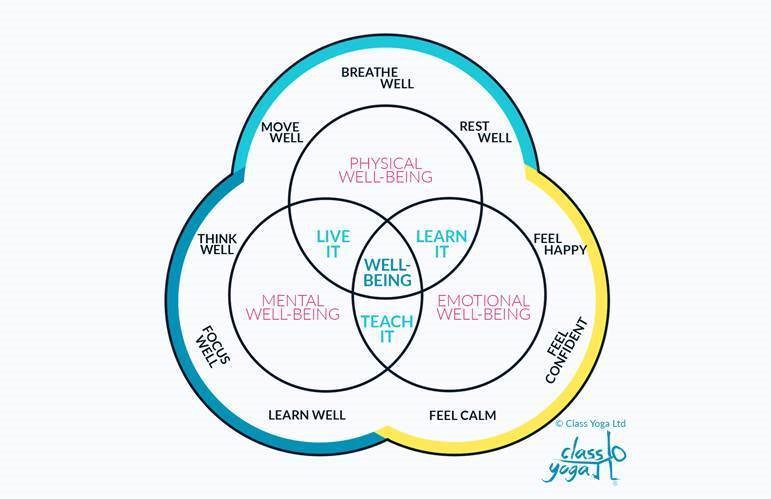
Drawing on my 11 year experience as a yoga teacher and Primary School Teacher, sharing yoga and mindfulness in the education setting – I believe there are 3 pillars to a person’s well-being that need to be focused on equally within the learning environment: physical well-being, mental well-being, emotional well-being. In this blogpost, I briefly summarise how yoga, when taught appropriately, covers all three.
Within the first pillar of Physical Well-being, we have ‘move well’ – because yoga allows everybody, no matter their athletic capability, to do safe, beneficial physical activity that maintains mobility and flexibility and improves strength, balance, coordination and posture. It’s free from competition – which removes the feelings of anxiety and inadequacy, that many young people feel about sport. It’s fully inclusive, so regardless of size and fitness, disability or culture, anyone can do it.
Yoga is not just movements and poses though, an intrinsic element is to ‘breathe well‘. Improved posture helps us to breathe more fully, simultaneously learning how to breathe more fully enables better posture. Yoga teaches us how to use our full lung capacity, instead of just the top of the chest. Full breathing not only provides the obvious benefits of higher oxygen intake but allows access to the parasympathetic nervous system; the place of rest and digest, where we feel calm and at peace – and where we should be spending more time than in the sympathetic nervous system, the place of flight, fright and freeze – but that’s often not the case for many people.
The other element to good physical wellbeing is being able to ‘rest well‘. Most people don’t intentionally set aside time for proper relaxation. Yet, it’s so important for our mental health, as much as physical. Authentic yoga provides relaxation and the time to be still and quiet – very possibly for the only time in someone’s day. It teaches children, and adults, how it feels to purposefully relax – to be, rather than do.

Photo by guille pozzi on Unsplash
Yoga is not a sport, even though it has a physical element. Yoga, as I see it, offers the best of non-competitive physical activity, that facilitates a mindful state of mind and the chance to rest and reset. When taught authentically and appropriately, the teacher aids the student (child or adult) in becoming completely absorbed in the movements and the sensations that they are feeling. Having the movement, as well as the breath and senses to focus on is why yoga, as mindful movement, is more effective than seated mindfulness meditation techniques for bringing someone into a mindful state of being – one of presence, calm, alertness, peace of mind and clarity of thinking[1].
So the first element to our Mental Well-being pillar is ‘think well’. This time to be quiet, in our own space, with our own body movement that’s not in competition with another, when given safe tools to help our mind become stiller and turn inward, rather than out – teaches us to notice thoughts and be less affected by them. We start to recognise emotions before they become feelings, and before they become words and actions. In this way, yoga enables a clarity of thinking and the ability to self-regulate thoughts, emotions and behaviour. Essentially being more responsive, less reactive; and I have found that many children crave this time of quiet.
This leads us to ‘focus well’. A study on the effects of yoga carried out at a school in Colorado, found that there was an 80% increase in focus on the teacher, after only two weeks of pupils taking part in yoga classes[1]. This could be attributed to the mindful state that is facilitated during a yoga class, and that with time, becomes a more consistent way of being. When any person, child or adult, feels calm, alert and present, we are in the optimal place to ‘learn well’. So before expecting a child to listen and learn, let us first give them the tools to feel relaxed and attentive in that moment, helping to maximise their learning potential.
The third pillar is Emotional Well-being. Everything goes better and functions better, when we ‘feel calm’. Yoga, when taught authentically and appropriately to the age and their needs, has the incredible effect of balancing energy levels. Yoga helps us to ‘feel confident’ – in the way that a child can clearly see and feel their own progress as they get stronger, more balanced and coordinated in poses. ‘Feeling happy’ is ultimately what everyone wants – and it’s something we all deserve. With a system in place to facilitate these 3 pillars and their elements coming together, happiness is likely to be around for longer, more of the time.
We’ve created a new well-being in education programme at Class Yoga, Well Ed™. It’s designed to help raise the well-being of pupils and educators, not only through expert made yoga and mindfulness video resources – but with professional development training and on-going support, to help schools achieve that ideal whole-school wellbeing environment. Find out more at https://classyoga.com/

[1] Mindful movement and skilled attention. Dav Clark, Frank Schumann and Stewart H. Mostofsky. Front Hum Neurosci. 2015; 9: 297.
[2] Yoga Prevents Bullying in School. Dee Marie, M.A., Grace Wyshak PhD, George H Wyshak, PhD. 2009. Harvard School of Public Health.
 Cambridge Wellbeing & Inclusion SIG