
A staffroom designed for relaxation and conversation
David Baker, BArch(Hons), PGCE, MPhil (Education Research) 1st Year PhD student at the Faculty of Education, Cambridge. Also advisor to School21 and the Big Education MAT on the design of their schools.
In the search for ways to improve teachers’ wellbeing, might there be some new ideas to be found at the intersection of wellbeing with workplace architecture and the design & provision of staffrooms and other staff welfare facilities?
The Problem
The reader of this blog may be well aware of the vast literature relating to wellbeing generally and teachers’ wellbeing in particular. By way of example, there is ample data showing that a majority of schoolteachers experience low levels of wellbeing and high levels of stress. A typical source is the annual Teacher Wellbeing Index published by the mental health charity Education Support (ES), giving figures such as 62% of all teachers describing themselves as stressed, a figure that rises to 77% for senior leaders. In recent years ES has also surveyed some 3000 teachers using the Warwick-Edinburgh Mental Wellbeing Scale (WEMWBS) producing data showing that teachers experience significantly lower levels of wellbeing than the rest of the population. (Savill-Smith, 2019; Renn, 2020).
The Repercussions
Similarly, there is data showing that low teacher wellbeing impacts negatively on pupils’ attainment. The causal sequence would appear to be a relationship between teacher wellbeing and pupil wellbeing, and thence from pupil wellbeing to pupil attainment. (Brooks, 2014) In a parallel process, ‘well’ teachers teach more effectively, and this also results in raised levels of pupil attainment.
In the same vein, poor wellbeing contributes to the ongoing difficulties of retaining teachers. ‘52% of education professionals (59% of senior leaders) had considered leaving the profession due to pressures on their health and wellbeing (in 2020). (Renn, 2020; p.6).
Current Solution
The range of interventions suggested by the government and quangos, commonly implemented by school leadership, focuses primarily on organisational changes and self-help techniques. The most commonly offered solutions are more staff training or reorganising teachers’ work, either by reducing the amount or by adjusting the type of work (Kingsnorth, 2018; Boxer, 2020) Many bodies are calling for reduced workload (e.g. National Education Union, 2018). In addition, activities such as yoga and wellbeing courses have also been shown to have some impact on individual teachers’ wellbeing but are sometimes dismissed as ‘well-intentioned added extras’ (Crome & Cise, 2020). A meta-study by McCallum et al. (2017) lists nine ‘initiatives’ that address ‘individual, relational and external spheres’ of intervention (p.32).
In terms of ‘grassroots’ wellbeing initiatives, there are a number of teacher-led (with some academic support) initiatives to promote pupil and teacher wellbeing, such as Action for Happiness and the Well Schools Movement. These tend to focus on cultural changes within schools to promote mindfulness and kindness.
My Big Idea
I believe that there are solutions that lie at the intersection between teacher wellbeing, the design and provision of staffrooms and associated welfare facilities, and workplace design ideas.
My idea is illustrated in the diagram below, together with the ‘repercussions’ links.

Preliminary Findings
I have been collecting school plans for some time. The plans below show two broad approaches to the location of staffrooms, either to locate the room at the centre of the school or in the furthest extremity of the school. My hunch is that this reflects two quite different attitudes to the relationship between teachers and pupils and the staffroom’s purpose.
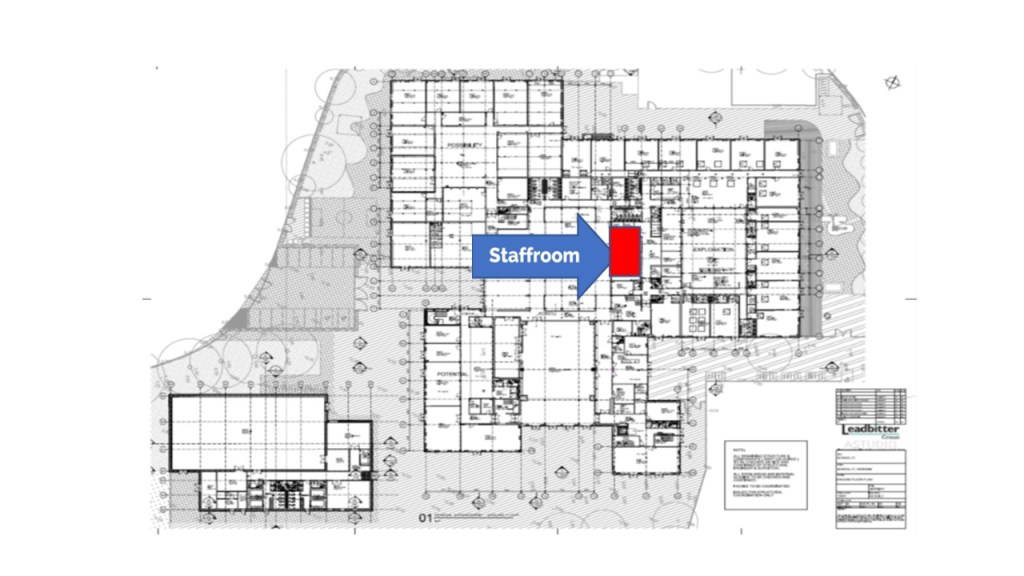
The location of a staffroom at the very centre of the school; visible and accessible to students, but stressful for staff.

The location of a staffroom at the furthest extremity of the school; invisible and inaccessible to students, but quiet and relaxing for staff.
I have also started to build up a photographic archive of staffroom interiors and furnishing. Thus far, there would appear to be three basic types of staffroom – a lounge to function primarily for relaxation and conversation; a workroom for marking, CPD and snacking, but not for relaxing; a hybrid that aims at both purposes.

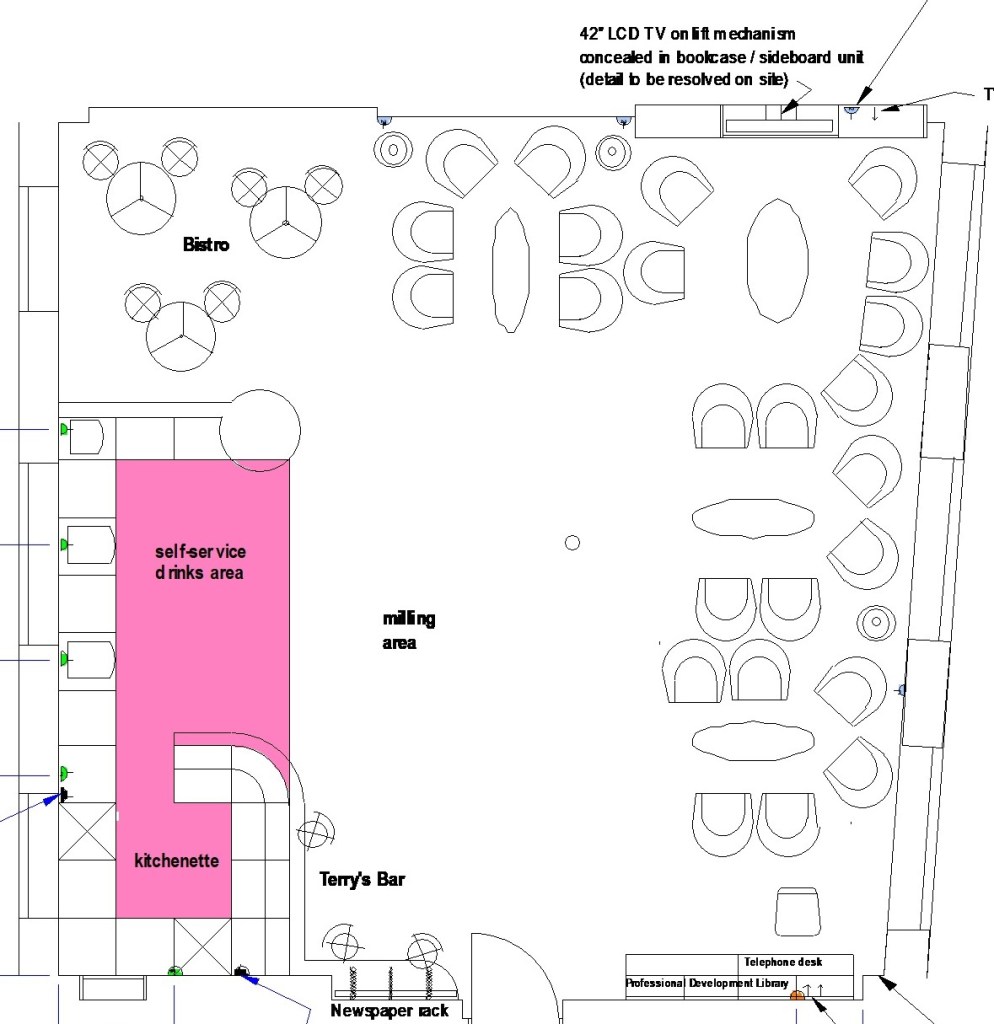
A staffroom furnished for relaxation and conversation – bucket armchairs, low coffee tables, a bar-type kitchenette, air conditioning and the pictures on the wall are 6th Form artwork. Note – the central tables in the picture were placed there temporarily for a bring & buy event. The central area is normally kept clear for morning briefings and as a general milling and chatting area during breaks.
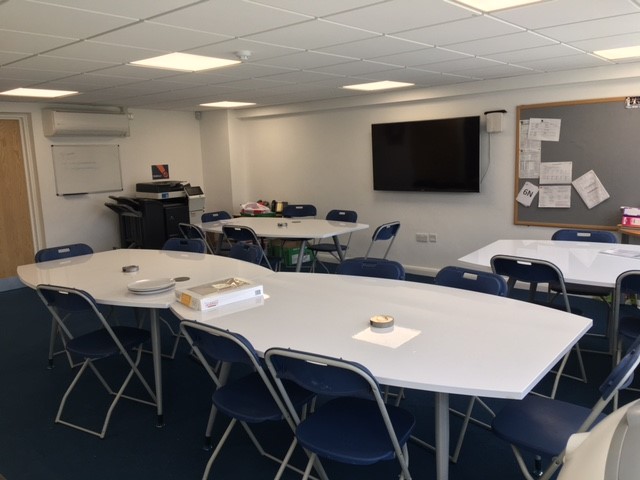
A staffroom furnished for snack lunches and CPD. No ‘soft’ seating, but large tables, computer screen, photocopier, air conditioner, whiteboard and pinboard.
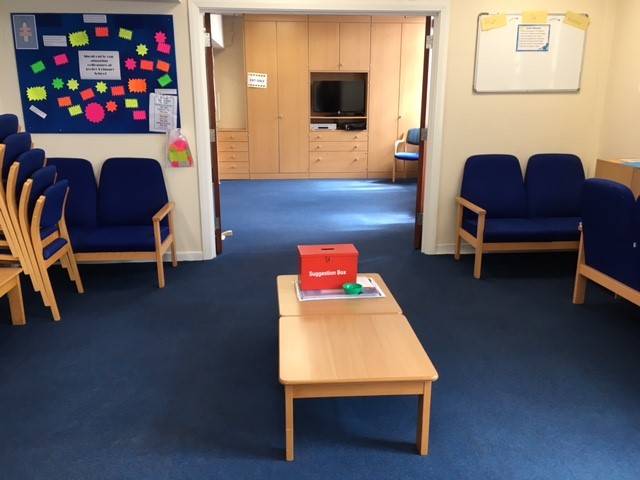
A staffroom furnished for relaxation with a linked room for CPD. Note – the seating has been reduced due to the pandemic, but normally the stacked chairs would be placed around the room. Note also the Suggestion Box on the coffee table.
Concluding Remarks
As can be seen from the plans and photos above, I believe there is much to learn about teachers and schools’ lives by studying their staffrooms. In time, I hope that this will lead to data showing a relationship to teachers’ wellbeing, pupil attainment, and staff turnover, which will lead to some authoritative policy notes and design guidance.
References
Boxer, A. (2020). Cutting workload – a couple of ideas. A Chemical Orthodoxy. https://achemicalorthodoxy.wordpress.com/2020/12/28/cutting-workload-a-couple-of-ideas/ Accessed 2021-04-01
Brooks, F. (2014). The link between pupil health and wellbeing and attainment. https://assets.publishing.service.gov.uk/government/uploads/system/uploads/attachment_data/file/370686/HT_briefing_layoutvFINALvii.pdf Accessed 2021-01-04
Crome, S., & Cise, R. (2020, May). Rethinking teacher wellbeing. Impact.Chartered.College. https://impact.chartered.college/article/rethinking-teacher-wellbeing/ Accessed 2021-04-22
Kingsnorth, S. (2018, January 13). How to Reduce Workload in Primary Schools. Medium. https://medium.com/solomonkingsnorth/how-to-reduce-workload-in-primary-schools-878158353e7c Accessed 2021-04-05
McCallum, Price, Graham, & Morrison. (2017). Teacher Wellbeing—A review of the literature. https://apo.org.au/sites/default/files/resource-files/2017-10/apo-nid201816.pdf Accessed 2021-02-21
National Education Union. (2018). Teachers and Workload. https://neu.org.uk/media/3136/view Accessed 2021-05-12
Renn, C. (2020, November 24). Teacher Wellbeing Index 2020. Education Support. https://www.educationsupport.org.uk/resources/research-reports/teacher-wellbeing-index-2020 Accessed 2021-05-12
Savill-Smith, C. (2019). Teacher Wellbeing Index 2019. https://www.educationsupport.org.uk/sites/default/files/teacher_wellbeing_index_2019.pdf Accessed 2021-02-05
 Cambridge Wellbeing & Inclusion SIG
Interesting idea, David. Are you advocating for staffrooms equipped for relaxation or do you think there is a role for the hybrid model?
LikeLike