
By David Baker, BArch(Hons), PGCE, MPhil (Education Research), 2nd year PhD student at the Faculty of Education, University of Cambridge.
INTRODUCTION
My thinking is thus: –
Wellbeing, however defined, is a part of an employee’s work experience. Looking things up on a website is also a part of an employee’s work experience. If, on the website, you don’t find information about yourself and your job, or prospective job, what does that say about a school’s view of its employees.
Am I invisible? Am I taken for granted? Am I valued?
This blog piece reports on some very preliminary thoughts following my review of the websites of the 34 state secondary schools and 13 Multi-Academy Trusts (MATs) in a particular English county.
RATIONALE
I am researching the design of schools and the wellbeing of staff. However, visits to schools during the pandemic have been sporadic, and so I have filled in my time by looking at school websites as a desk-based method for investigating life in schools. I have been encouraged to try this by reading Rose’s ‘Visual Methods’ (4th Ed. 2016 with a new Chapter 11 on Digital Methods: Digital images, Digital Analysis) and Jackson & Bazeley’s ‘Qualitative data analysis with NVivo’ (3rd Ed. 2019, especially Chapter 10 about analysing Twitter, Facebook, YouTube and web pages). I believe this is a useful method when face-to-face access is limited.
CAPTURING THE DATA
One can capture text, or images, or both together, from a website. Each requires a different process and each will, to a lesser or greater degree, retain features of the original page such as the hyperlinks or the layout. Thus, a key decision at the outset is to decide whether one is interested in analysing text or images or both.
In my case I simply wanted to find out what the websites contained that might reveal the school’s approach to staff wellbeing, and then to analyse those findings; content analysis, in other words. I therefore felt that I needed to capture complete web pages rather than just the text or just the images.
Without listing all the experiments that I tried (copy & paste, print screen, web capture or web select in Microsoft Edge, Adobe Acrobat web tool etc.) I would say that there is no single ideal system for doing this.
In the end I opted to use the free NCapture extension to NVivo Pro, V.12. This creates pdf files of entire web pages and retains all hyperlinks and a fairly accurate image of the page design and layout.
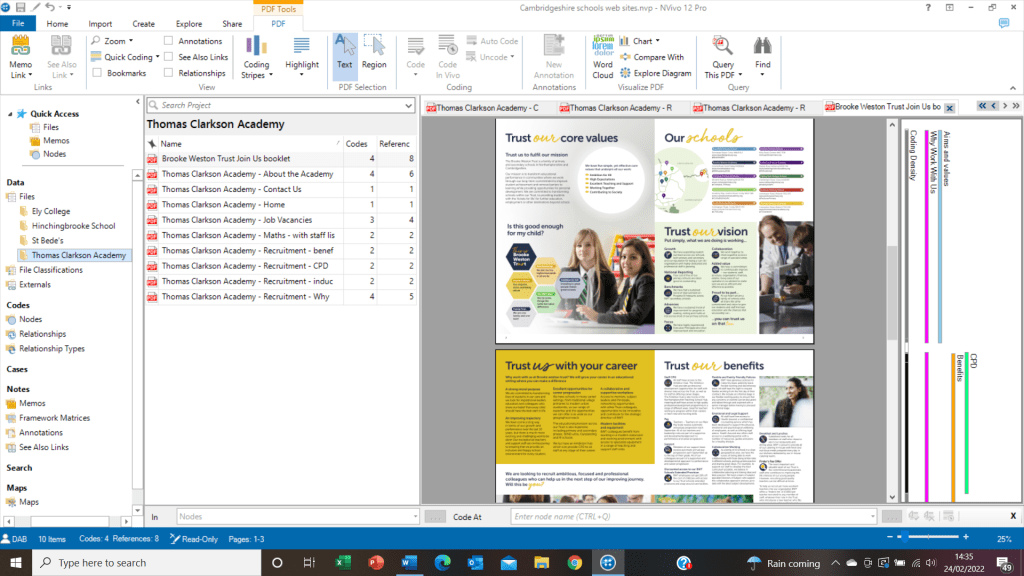
Once imported into NVivo, both text and ‘regions’ (NVivo’s term for images) on the page can be coded and annotations etc. added in the usual way. A typical page in the process of coding looks as shown below.
CODING AND ANALYSING THE DATA
Having established ‘parent’ nodes for the web pages that I was interested in (Home, About Us, Vacancies etc) I built up a more detailed system of ‘child’ nodes during my review. I coded for what I felt indicated an interest in the staff, such as a ‘Why work with us’ page or a ‘Benefits’ page. I also annotated certain items such as a staff list with a comment about how easy it was to find and if it included all staff, including support staff, or only the SLT. A screen shot of my coding structure is shown below.
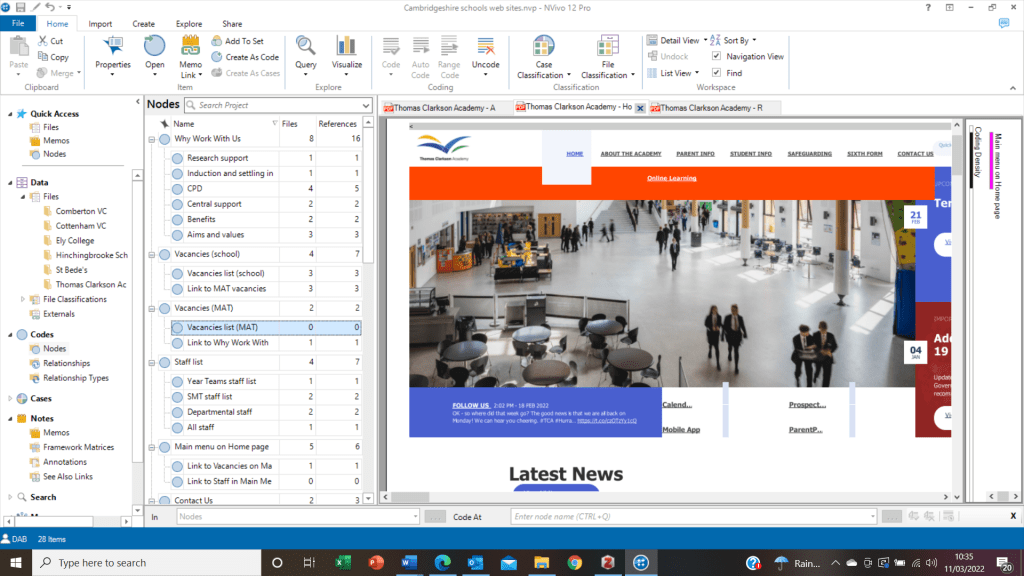
I was thus able to add up the total number of references to features of interest to arrive at a score of how much was to be found on the site that related to staff – a kind of Staff Awareness Score (SAS). I didn’t adjust the reference scores for relative importance.
My hope was that this might give me a sense of the approach being taken by the school towards their staff, and by way of proxy, a possible indicator of staff wellbeing. In crude terms, and as suggested above, my theory was that a staff that was invisible on the website was perhaps an overlooked and maybe unhappy staff.
ETHICAL ISSUES
The website data that I am accessing is all freely available and presumably has been put into the public domain intentionally for people to read. It is not confidential and it is difficult to see what harm is being done to anyone by looking at it. The primary audiences are however prospective parents and employees, and existing pupils and parents, and one can reasonably question whether it is right to access it for a different purpose. What did the authors expect?
A second issue relates to the reliability of the data as an indicator of a school’s wellbeing policies. It may well be that the SLT simply pay little attention to their website and that it might be long out of date. But that tells its own story.
OBSERVATIONS
The SAS numbers varied widely from 9 at one end of the scale to 33 at the other. For the school that scored 9, there was, for example, no whole-staff list and no suggestion on the Vacancies page of why someone should want to work at the school. At the other extreme, not only was every single member of staff listed, with emails and job titles, but there was information about a comprehensive package of staff benefits as well as details about an insurance-backed employee assistance scheme. These and similar staff-related matters can be easily identified on websites, and there is relatively little subjectivity in thus scoring for their presence or absence.
CONCLUSIONS
Understanding this variation is not easy. Based on this limited data set however it can to some extent be explained by the size of the school; the larger schools (say over 1200 pupils) tend to employ HR professionals who are more alert to this issue and are more likely to influence wellbeing policies. Their bigger budgets can also more easily provide a benefits package and they commonly have sports centres or fitness centres which staff enjoy. But clearly some people also like to work in smaller (say 800 pupils) schools.
Given concerns about reliability and generalizability, I think the SAS can only ever be one element in researching the employees’ experience in a particular school. A full picture of life in a school can only be grasped through a much broader battery of methodologies and methods.
 Cambridge Wellbeing & Inclusion SIG
Interesting post David and raises interesting ethical questions – down the line we’ll be interested in knowing whether there is any connection between website SAS and staff wellbeing gleaned from more detailed and sustained engagement with school contexts
LikeLike