
Can we learn anything about a school’s approach to wellbeing by looking at what’s on the walls?
by David Baker
I embark upon this blog taking inspiration from the words of Henri Lefebvre in his essay ‘The Everyday and Everydayness’ (1987). Thus, ‘The proposition here is to decode the modern world, that bloody riddle, according to the everyday’ (p.9). Lefebvre goes further than simply aiming to ‘decode’ by suggesting that through studying the everyday one might ‘… reveal the extraordinary in the ordinary’ (p.9). Does this approach also have the potential for school improvement ideas, as suggested by Nathaniel Coleman? ‘The everyday holds out the promise of an in-depth understanding of the present while also being the source of its radical re-invention ….’ (2015, p.36).
These thoughts have led me to study the everyday lives of school staff, with the ultimate aim of revealing the relationship between their wellbeing and their surroundings. And there is nothing more ‘everyday’ than the posters and notices that fill the walls of schools (alongside the backs of toilet doors, as I have discovered). This is because school leaders appear to cherish the belief that they can communicate a wide variety of messages to staff and pupils through this medium.
So, no great theories here, just a collection of pictures with my thoughts attached. They illustrate this aspect of the everyday surroundings of those who inhabit schools, the words they read and the sights they see as they go about their school lives.
| A large poster from the entrance lobby of an Ofsted ‘in need of improvement’ school. Staff, students and visitors would all walk past this. A good message but delivered by a slightly subversive character, I wonder about the Senior Management Team’s (SMT) debates about its suitability. |  |
| Many schools now have screens mounted at key points around the school, as here in the dining room of an Ofsted ‘good’ school. Perhaps it is more aspirational to quote Aristotle rather than John Lennon? Does this make it a ‘good’ school? |  |
| Some schools use any available surface to send out motivational messages which debatably speak to staff as well as students. These messages are on the queuing barriers in the servery. With the support of Pablo Picasso and Napoleon Hill, it would seem that success through action, and achievement through mental effort, are the educational goals of this school. | 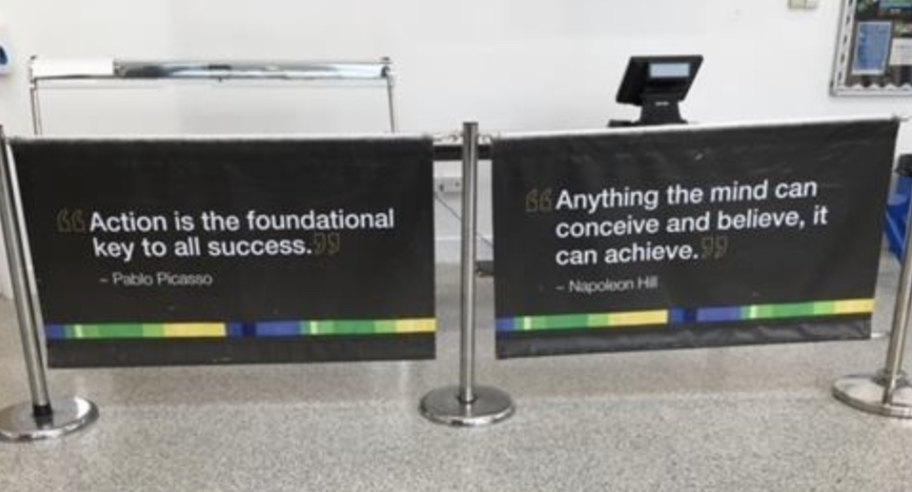 |
| One of my ‘behind the toilet door’ photos, these posters are from a male staff toilet. Are the posters there because the SMT understand that it is to a toilet cubicle that staff go when they feel depressed and tearful? One wonders if they are there as an act of kindness. | 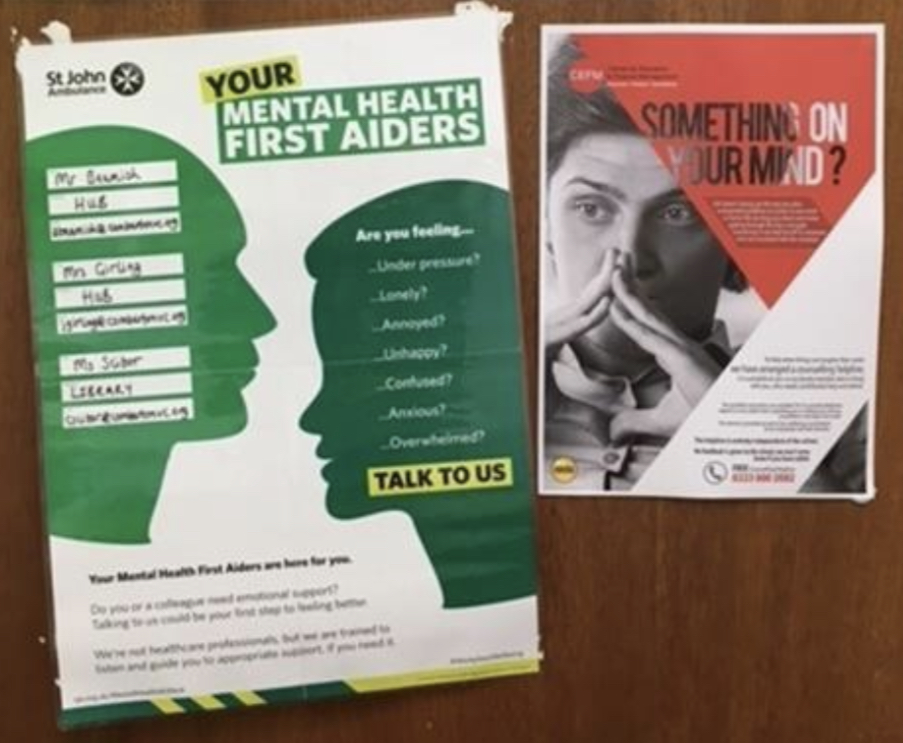 |
| Posters from the Education Support Partnership are to be found in many school staffrooms. Directing staff to this charity seems to be a part of almost every school’s wellbeing policy.You can judge the age of these posters by the fact that the charity changed its name to Education Support in 2015. The concern is that a poster that has been on the wall for so long is simply not ‘seen’ – it becomes part of the wallpaper – and its important message is lost. |  |
| Another staffroom poster from Education Support Partnership. The pencil, often a symbol of creativity and invention, has here been repurposed as a symbol of stress. The suggestion is that the teacher has perhaps snapped as well as the pencil. The typography emphasises the ’Tough day’ rather than the ‘We’re listening’ and thus perhaps the message is more about the difficulties of teaching than the offer of support. |  |
| This poster uses a template provided by the charity Mind and has been posted by the Well-being Team in this school. The motto ‘proud to support, time to change’, and the bunting, send a rather mixed message. Is this to be a light-hearted social gathering, as would be indicated by the bunting and the ’Meet for a chat’ or is it something more therapeutic as indicated by the ‘Mind’ logo at the foot of the poster. |  |
| A notice board from the staffroom in an Ofsted ‘outstanding’ school. Is this what makes a school ‘outstanding’? It is certainly uncommon. | 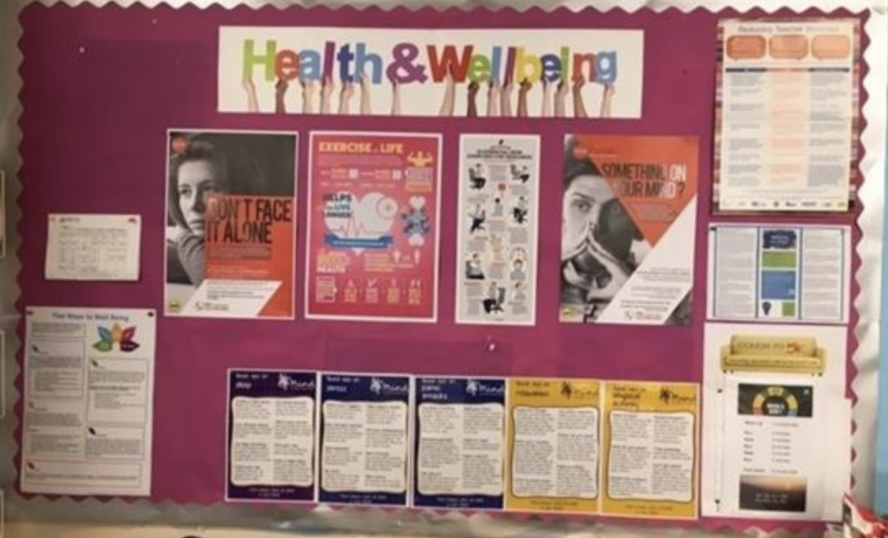 |
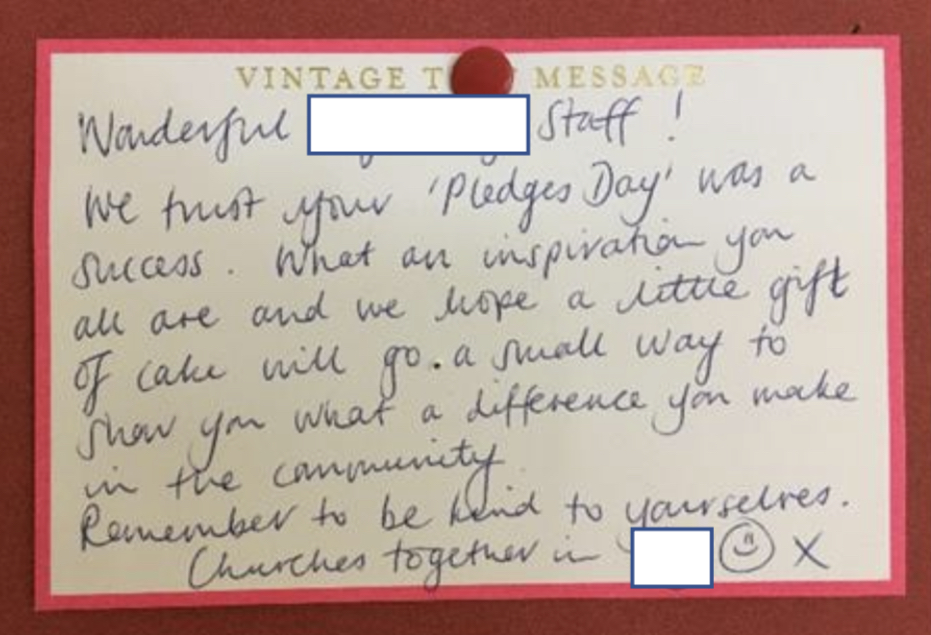
| Staff ‘shout out’ noticeboards are a feature that I’ve noted in several schools, both Secondary and Primary. They provide the opportunity for individuals and organisations to say nice things about the staff. Local churches seem to be a common source of the ‘shout out’ postcards as shown in these from two secondary school staffrooms. |  |
 | |
| Union notice boards are often very full of messages, mainly about recruitment, but in this case they are presenting the union as ‘your friend in the workplace’. The suggestion here is perhaps that the reader has few other friends in the school. | 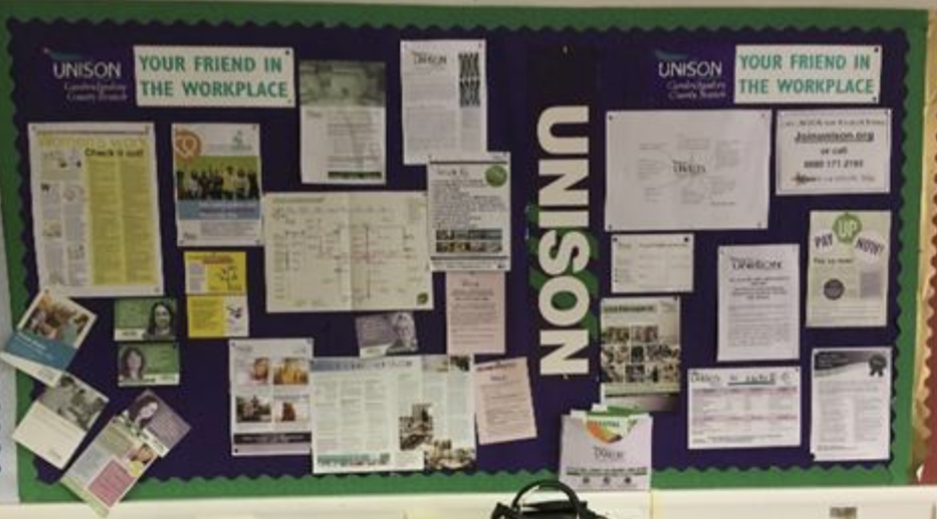 |
| Another trade union poster adding to the sense of stress. The suggestion that the NASUWT ‘puts teachers first’ implies that others – school managers? the Government? – are not putting teachers first – and that the reader has ‘had enough’. The image of a stressed teacher surrounded by a cascade of problems further adds to the demotivating message. |  |
| This ‘Bic & Brew’ poster from a department office gives me hope and speaks of camaraderie and light-heartedness. It also indicates that this team gets together socially every Thursday break.One wonders who came up with the nicknames, and what happens if you don’t like yours. Having to accept this and fit in might be as detrimental to wellbeing for some, as it might be uplifting for others. |  |
| SMT seem to have a penchant for coming up with mottos, often with a catchy mnemonic to help pupils remember it. However, staff walk up and down these stairs too, so does it penetrate their consciousness also?Every staircase in this secondary school carries this message of C.A.R.E. | 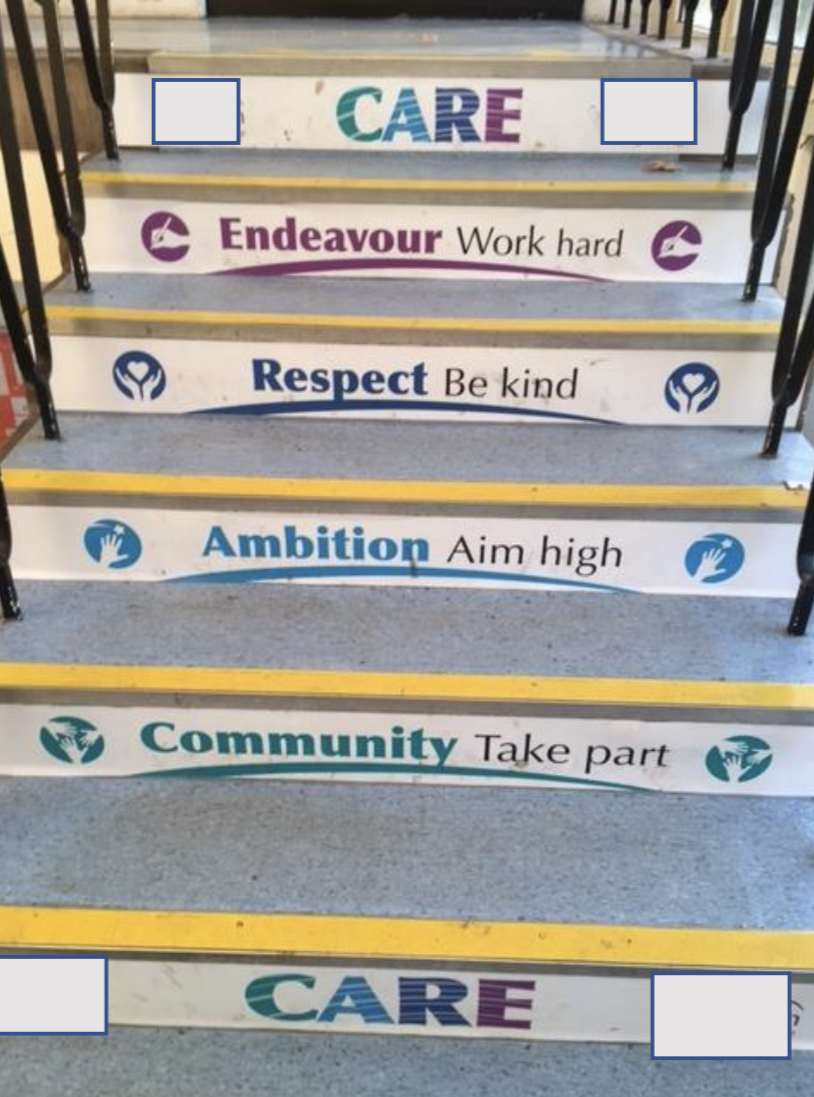 |
| A curious piece of ephemera from a staff toilet in a secondary school. It advertises some of the benefits that the school has arranged as part of their wellbeing policy, including discounts at local shops and free membership of the nearby leisure centre. |  |
| A slightly more chilling sign to end with. Is this a message for the pupils or the staff? Slight shades of 1984? But at least kindness does feature, even if it is only sandwiched between work and achievement. | 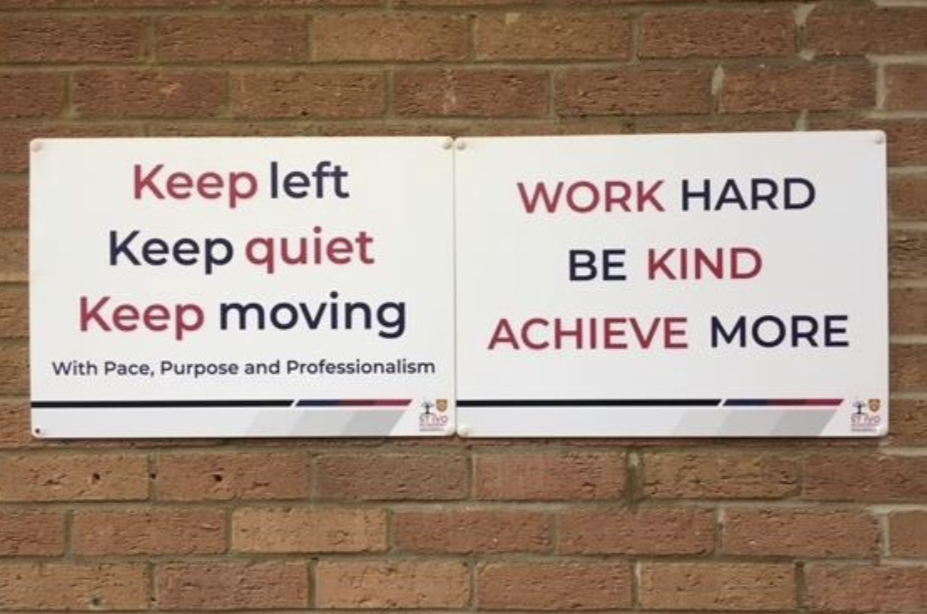 |
In summary, the everyday surroundings of school staff contain a wide range of messages, some motivating, some perhaps demotivating. Whether these messages are absorbed consciously or subliminally requires further research, as would their impacts on the wellbeing and quality of life of those spending a large part of their adult lives in school and with children.
References
Lefebvre, H. (1987). The Everyday and Everydayness. Yale French Studies, 73(73), 7–11. https://doi.org/10.2307/2930193 Accessed 1/1/23
Coleman, N. (2014). Lefebvre for Architects (1st edition). Routledge
 Cambridge Wellbeing & Inclusion SIG
What an interesting blog piece, David. It made me reflect on the posters in the social area of the Faculty. To what extent do these reflect an SLT vision or a more grassroots view though?
Ros
Dr Ros McLellan University Associate Professor in Teacher Education & Development / Pedagogical Innovation Fellow of Homerton College
Faculty of Education University of Cambridge 184 Hills Road Cambridge CB2 8PQ
01223 767663
Latest publication McLellan, R., Faucher, C., & Simovska, V. (Eds.). (2022). Wellbeing and Schooling: Cross Cultural and Cross Disciplinary Perspectives. Wellbeing and Schooling | SpringerLinkhttps://link.springer.com/book/10.1007/978-3-030-95205-1
LikeLike