
by David Baker
There are child-friendly schools (1) and family-friendly schools (2). There are asthma-friendly, dyslexia-friendly and deaf-friendly schools (3). There are manuals (4) and web sites devoted to the idea of schools that are ‘friendly’ to particular groups of pupils such as wheelchair users (5) or autistic pupils (6). What I have been unable to find, anywhere, are staff-friendly schools.
Why is this? Maybe there aren’t any? Maybe it’s just not acceptable for schools to see themselves in this way? But at a time when recruitment and retention are routinely described as in crisis (7) surely this is exactly the identity that schools should be promoting.
So I’m testing out this idea of friendliness as a more practical and user-friendly (can’t escape the term) approach to the implementation of a school’s wellbeing policies.
I’m basing what I say on observations and insights gained in my multi-case, mixed methods study of four Secondary schools in Cambridgeshire and a pilot study of an independent school in London. Whilst I realise that it is difficult to generalise on the basis of a sample of five, I can share real examples of what I’ve seen. When taken together, these observations suggest that staff-friendliness is a worthwhile goal for school leadership teams (SLT).
My argument
I will make two claims about staff-friendly schools.
Firstly, the SLT devote as much time and effort to thinking about the needs of the staff as the needs of the pupils. And this word ‘needs’ is important in SLT’s policies. From my conversations with head teachers, they recognise three basic needs for staff to do their job – sufficient pay, adequate initial training, and good working conditions. However, recognising that they have limited options when it comes to pay and initial training, SLTs focus on working conditions, both the tangibles (like offices, toilets and refreshments) and the intangibles (like part-time working and the daily timetable). They may also put more effort into CPD (Uttley & Tomsett, 2020) but this is very variable.
Secondly, they use elements of an employee experience (EEX) design approach in their HR function, often without even knowing it. EEX emerged in the progressive HR world around 20158 and some relevant papers are listed in Further Reading below. There are several formulations of the essential features of EEX but those that I’ve noted in staff-friendly schools are: –
1. They understand (or at least try hard to understand) individual employee’s needs in depth
2. They identify key moments (touchpoints in EEX jargon) that matter to the employee, and design improved touchpoints
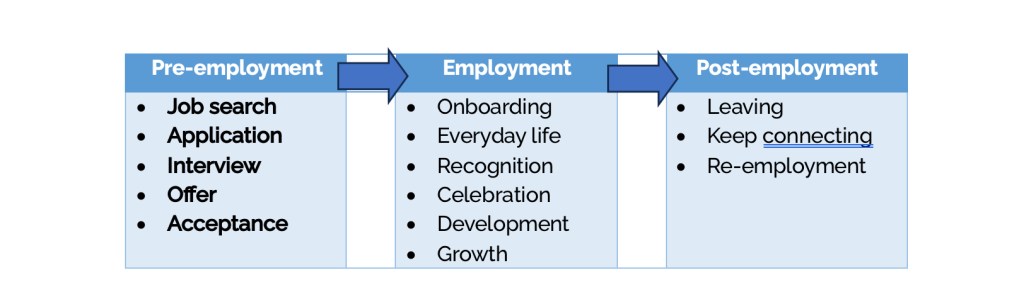
3. They are aware of the entire employee journey from pre-employment, through employment, to post-employment.
Fig. 1 below is a flowchart, adapted from Plaskoff (2017), to reflect some of the touchpoints I’ve noted in my research.
Methodologies
I have used a mixed-methods, multi-case study approach. The process involved a pilot study (n=1), desk-based scoping study (n=34), on-site scoping study (n=15), multi-case studies (n=4), on-line survey of staff (n=260), and embedded case studies (n=12).
My sampling has been theoretical, based on a range of criteria including size and location of school, and Ofsted grades. My data gathering has involved on-line surveys, web-based data mining (especially of government sources), visual methods (site photos and architectural drawings), site observations, interpretative phenomenological analytic (IPA) interviews, and the collection of ephemera from each school. Analysis has been carried out using Qualtrics, NVivo and Excel.
Findings
A mixed-method, multi-case study produces a great deal of information. For this blog I have selected the results of the on-line survey of self-reported wellbeing using the fourteen Warwick Edinburgh Mental Wellbeing Scale9 questions to illustrate the relationship between staff wellbeing and Ofsted grading. The four charts below give the percentages of staff ‘feeling good and functioning well’ all of the time, often, some of the time, rarely, and none of the time in each school. (The pilot study school is not included in these charts).
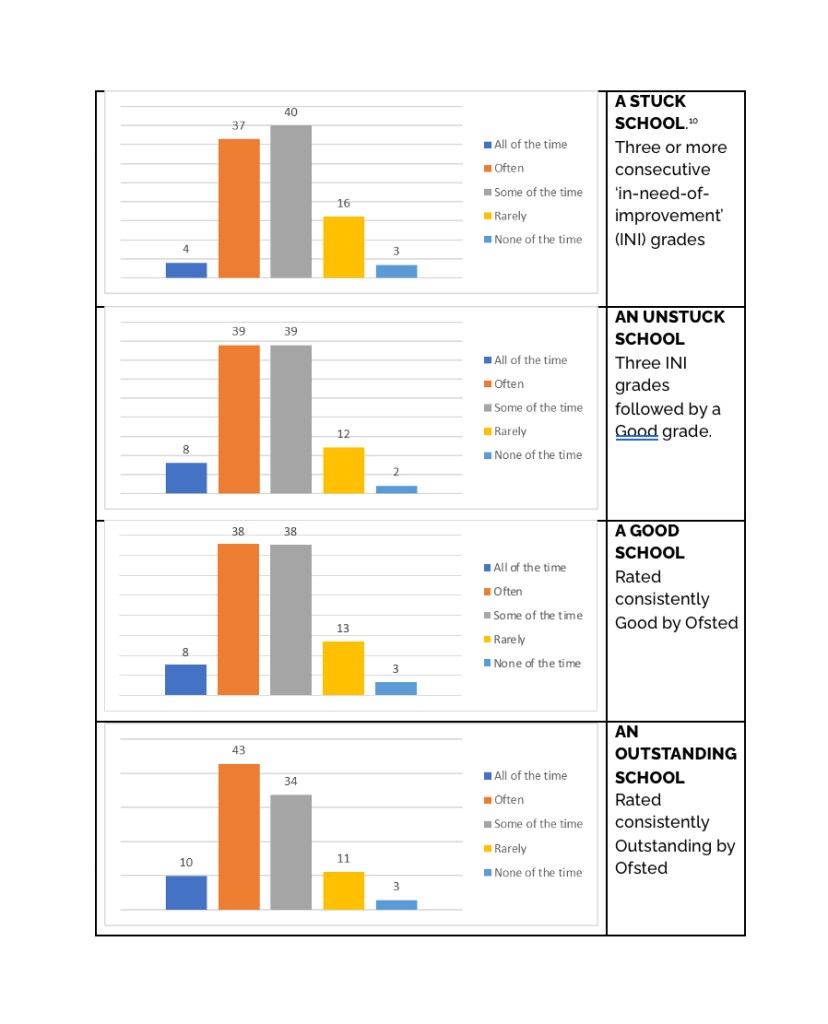
In the ‘stuck’ school, 41% of the staff feel good all the time or often. In the ‘unstuck’ and ‘good’ schools that figure rises to 47% and 46% respectively; and in the ‘outstanding’ school, the figure is 53%. There does seem to be a trend. This set me on the path to examine those aspects of each school that might be described as ‘staff-friendly’, to see if there is evidence to support this trend and my claims.
Claim 1 – staff working conditions
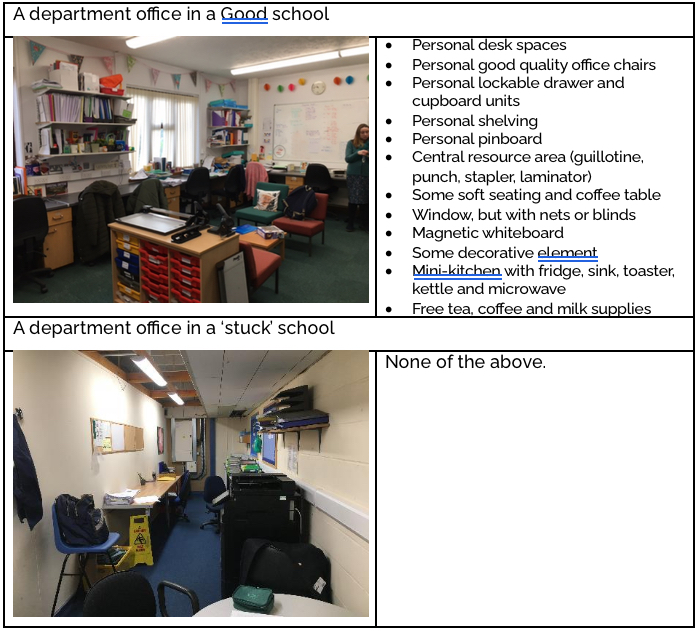
Working conditions is a broad term that covers a wide range of experiences in the employee journey. One must make allowances for the age of the building, but in terms of everyday life, department offices seem to be a good indicator of the effort that has been made to ensure that everyone has somewhere pleasant and efficient to work. The examples below illustrate the differences between the Good and the ‘stuck’ school.
Claim 2 – employee experience design
Without access to the minutes of SLT meetings one cannot say the extent to which EEX thinking is happening at a particular school. However, one can perhaps see some of the results of that thinking in the way that the school describes its benefits on the Vacancies pages of its web site, an important part of the Application stage of the employee journey.
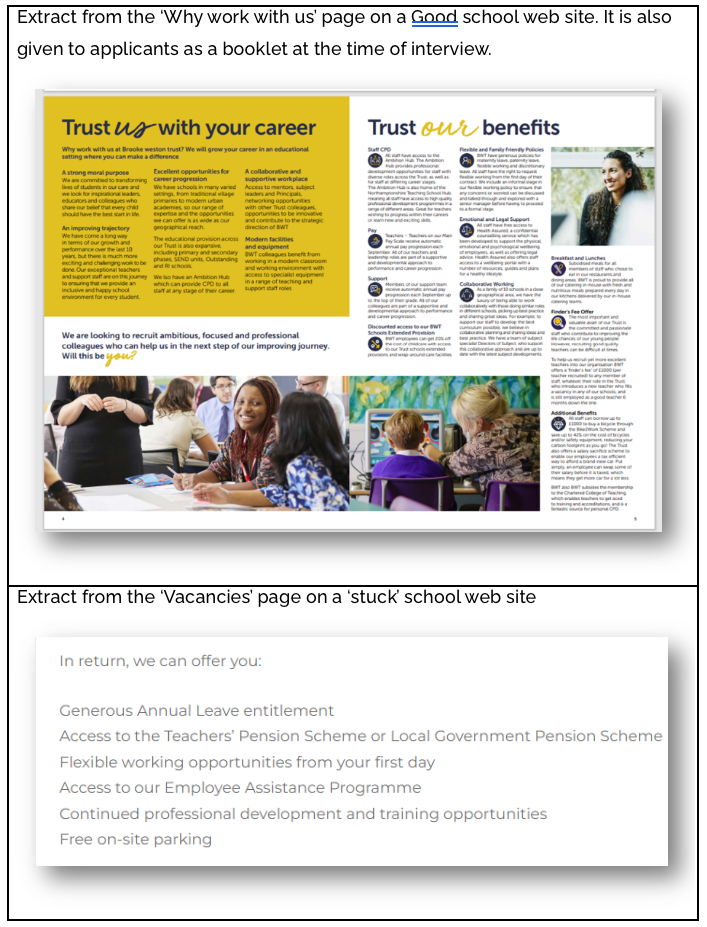
You decide which is friendlier.
References
1 UNICEF USA. (n.d.). Child-Friendly Schools. UNICEF USA. Retrieved 2 July 2023, from https://www.unicefusa.org/what-unicef-does/childrens-education/child-friendly-schools
2 Dunn, H. (2017, January). Family Friendly Schools | MTPT. https://www.mtpt.org.uk/family-friendly-schools/family-friendly-schools
3 Deaf-friendly teaching: For primary school staff. (2020, July 31). https://www.ndcs.org.uk/documents-and-resources/deaf-friendly-teaching-for-primary-school-staff/
4 UNICEF. (2009). Child-friendly Schools Manual. https://www.unicef.org/media/85731/file/Child_Friendly_Schools_Manual_EN_040809.pdf
5 Hurrell, S. (2018). Wheelchair friendly schools, SEN Magazine. https://senmagazine.co.uk/content/specific-needs/cerebral-palsy/7700/wheelchair-friendly-schools/
6 Peat, M. (2017). Designing schools for autistic pupils. https://www.autism.org.uk/advice-and-guidance/professional-practice/designing-schools
7 For the latest data, see for instance this briefing note from the House of Commons Library – Long, R., & Danechi, S. (2023). Teacher recruitment and retention in England. https://commonslibrary.parliament.uk/research-briefings/cbp-7222/
Further reading
Plaskoff, J. (2017). Employee experience: The new human resource management approach. Strategic HR Review, 16(3), 136–141. https://doi-org.ezp.lib.cam.ac.uk/10.1108/SHR-12-2016-0108
Tran, H., & Smith, D. (2021). Talent-Centered Education Leadership: Using the Employee Experience to Improve Teacher-School Relations. The Journal of Cases in Educational Leadership, 24(1), 42–54. https://doi.org/10.1177/1555458920976724
Tran, H., & Smith, D. A. (2020). Designing an Employee Experience Approach to Teacher Retention in Hard-to-Staff Schools. NASSP Bulletin. Volume 104:Number 2 (2020); Pp 85-109. https://cam.ldls.org.uk/vdc_100102323575.0x00000c
Tucker, E. (2020). Driving engagement with the employee experience. Strategic HR Review, 19(4), 183–187. https://doi-org.ezp.lib.cam.ac.uk/10.1108/SHR-03-2020-0023
Uttley, J., & Tomsett, J. (2020). Putting staff first: A blueprint for revitalising our schools. John Catt.
 Cambridge Wellbeing & Inclusion SIG
Interesting ideas David. I wonder if it partly comes down to resourcing – I can imagine not all schools can afford to refit a departmental office with soft furnishings etc. I’d be interested to learn if these ideas resonated with colleagues teaching in these contexts.
LikeLike