
Good corn is not reaped from a bad field (Language Hobo, 2022)
Catherine Fraser-Andrews February 2024
Introduction
The Wellbeing and Inclusion Specialist Interest Group were delighted to welcome Professor Venka Simovska from The Danish School of Education, Aarhus University, as our first guest speaker of 2024. The Danish School of Education has an ethos of academic pluralism and cross-disciplinary research, and it embraces diversity in all its forms. Professor Simovska has written extensively about the intersection of diversity and wellbeing with reference to gender, sexuality and social background. At the SIG, Professor Simovska presented her current research in which she seeks to expand the concept of wellbeing. By moving away from objective, standardised and externally imposed definitions of wellbeing, toward subjective, multi-dimensional and fluid definitions (McLellan et al., 2022), Simovska aspires to enable a contextual understanding of children’s wellbeing that takes careful account of relationships and support systems in school. Simovska (2024) argues for the use of multidimensional models of wellbeing in schools that create space for consideration of the diverse influences on wellbeing, such as age, gender and social circumstances, as well as the consideration of diverse domains of wellbeing, such as emotional, academic and social. Simovska and colleagues (2022) argue that by thinking about wellbeing in this way, teachers will be better equipped to understand and foster the wellbeing of all of their students.
Diversity vs Normativity in the Emotional Domain
In their axes of normativity model, Primdahl & Simovska (forthcoming) explore the role of diversity in the domain of emotional wellbeing (see figure 1 below). Across the lifespan, emotional wellbeing is strongly correlated with healthy social and emotional development in childhood (NICE, 2022). The social and emotional skill of knowing how to make friends, for example, is crucial to emotional wellbeing in adulthood (Pezirkianidis et al., 2023). Primdahl & Simovska’s (forthcoming) axes of normativity model has application for emotional wellbeing in schools and is extended here to the concept of social and emotional development in schools.
Figure 1: Diversity vs Normativity in Emotional Wellbeing in Schools
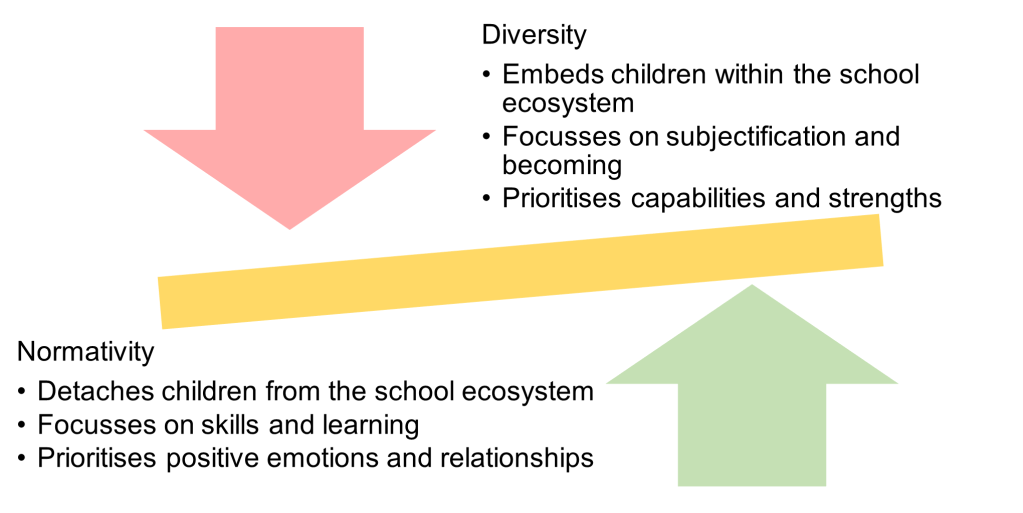
Adapted from Primdahl & Simovska (forthcoming)
Schools play a crucial role in children’s social and emotional development, and this is particularly true for children who have experienced adversity (McLellan et al., 2022; Wilson & Wilson, 2015). Children experience social and emotional learning opportunies in school in diverse ways (Goodman & Cook, 2019). For example, whilst receiving negative behaviour points might be insignficant some for children, for others it can lead to a diminished sense of self which hinders their social and emotional development (Carter, 2021a; Goodman & Cook, 2019). Whilst an authentic greeting as they arrive in the classroom in the morning might be business as usual for many children, for others it is not. Some children are not accustomed to being greeted warmly and authentically, and yet it is fundamental to their healthy sense of self (Shields-Lysiak et al., 2020). The normative approach to social and emotional development consists of developmental checklists, assumptions, and acceptable standards of emotional expression. Children whose social and emotional development does not follow the age-standardised trajectory, risk being labelled as ‘abnormal’ (Wilson & Wilson, 2015, p. 54) and relegated to the uneducable out group (Ball & Collet-Sabé, 2021). In its most recent estimate, The National Association for Special Educational Needs (2021) reports that, in England, the rate of permanent exclusions among children identified as having a social, emotional and mental health need (SEMH), is fifteen times higher than their peers without an identified special educational need. Primdahl & Simovska’s (forthcoming) axes of normativity is a tool that allows us to till the soil of social and emotional development and consider how schools might better prepare the field for the cultivation, nurture, and inclusion of children who do not fit the socio-emotional norm.
Embedding children within the school ecosystem

A school embracing children’s social and emotional diversity would understand that children grow up in schools, not apart from them (Procter & Lamb, 2013; Wilson & Wilson, 2015). It would be accepted that children’s identities are socially constructed through the ways in which their emotions are interpreted by others (Procter & Lamb, 2013). Therefore, children’s social and emotional development and expression would always be understood within the context of their lived experience (McLellan et al., 2022; Wilson & Wilson, 2015). For example, a child from a family with involvement in the criminal justice system, might understandably find it very difficult to trust the adults in school. This mistrust might be communicated, for example, through oppositional behaviours that others find threatening, but would be understood by the school as a threat response (Waller, 2006). A child in this situation would be supported intentionally by teachers, over time, to learn how to seek and accept help, which is vital for a healthy adult life (Carter, 2021b). In the school that celebrates emotional diversity, the notion of the ideal student who conforms to emotional norms, would not exist (McLellan et al., 2022). In the same way that teachers readily adapt resources, and scaffold activities, for children with different reading levels for example, resources would be adapted, and activities scaffolded, for children with different levels of social and emotional development (Carter, 2021b).
Focussing on subjectification and becoming

Social and emotional development is a journey of many steps. In a school where this is accepted, the focus would be what the child can do, and on celebrating their progress against their own social and emotional starting point (Carter, 2021a; Wilson & Wilson, 2015). Within a supportive school ecosystem, all children would be encouraged to have, and to learn about, a wide range of different emotions at different times, and to experience their whole humanity safely (BØRNS VILKÅR, 2022). Children would be supported to tolerate, and make sense of, their difficult emotions, and to explore these through play and open dialogue (Procter & Hackett, 2017). A healthy relationship with the whole range of emotions would facilitate children’s self-acceptance, and equip them to use their emotions to navigate the pressures of the outside world as adults (McLellan et al., 2022). Most importantly, recognising the substantial diversity in the ways in which children express their emotional distress, would allow for early identification and intervention for children in need of additional support and care (NICE, 2022).
Prioritising capabilities and strengths

Research from psychology and neuroscience presents variance in social and emotional development and expression as ‘the norm’ (Barrett, 2018, p. 15). Child-centred planning is an approach which schools might adopt to embrace this variance. In this approach, planning focusses on the child’s ‘gifts and who they are’ (Carter, 2021a, p. 20) and seeks to develop these. Carter (2021b) offers a framework for involving the child in the planning process, empowering the child to set their own goals, and providing the intrinsic motivation to achieve them. In England, children who express their emotions in ways that challenge the accepted norm, are less likely to be heard, and less likely to be included in opportunities for student voice and advocacy (Procter & Lamb, 2013). A school which values diversity over normativity, would employ a variety of ways to promote all children’s voices. Activities such as graffiti walls or card sorting, and technology such as Photovoice or Mentimeter offer diverse ways to engage children in advocacy (Carter, 2021a; CORC, 2021). The early development of self-advocacy is crucial for a healthy adult life, for example, in ensuring that employers make the right accommodations for the individual, or having a voice in healthcare decisions (Clarke, 2019). Moreover, listening to children with diverse social and emotional needs would send a message to teachers, schools and policy makers that all children have valuable contributions to make.
Concluding Thoughts

As infants, our emotional development happens far sooner than our cognitive development (Malik & Marwaha, 2024). It should therefore perhaps be anticipated that children will arrive at school with substantial differences in their social and emotional profiles. Primdahl & Simovska’s (forthcoming) axes of normativity model has much to offer schools to support their thinking about meaningful wellbeing, and about the roots and shoots of social and emotional development. If schools can make this shift, we might create a god ager which nourishes and nurtures the growth of all children.
References
Ball, S., & Collet-Sabé, J. (2021). Against school: An epistemological critique. Discourse: Studies in the Cultural Politics of Education, 1–15. https://doi.org/10.1080/01596306.2021.1947780
Barrett, L. F. (2018). How emotions are made: The secret life of the brain (Paperback edition). PAN Books.
BØRNS VILKÅR. (2022). Børn og unge kæmper for at passe ind (Children and young people struggle to fit in). BØRNS VILKÅR. https://bornsvilkar.dk/wp-content/uploads/2022/08/Boern_og_unge_kaemper_for_at_passe_ind_29082231.pdf
Carter, J. (2021a). SEND assessment: A strengths-based framework for learners with SEND. Routledge.
Carter, J. (2021b). SEND intervention: Planning provision with purpose. Routledge.
Clarke, A. (2019). How to build the foundation for self-advocacy in young children. Understood. https://www.understood.org/en/articles/how-to-build-the-foundation-for-self-advocacy-in-young-children
CORC. (2021). Good practice examples from ‘Hearing the Voice’ of children and young people with moderate, severe or multiple and profound learning disabilities (3; Gathering Feedback and Measuring Outcomes and Change with Children and Young People with Learning Disabilities (LD)). The Anna Freud Centre. https://www.corc.uk.net/media/2878/good-practice-examples-hearing-the-voice-of-children-and-young-people-with-moderate-severe-or-multiple-and-profound-learning-disabilities.pdf
Goodman, J. F., & Cook, B. I. (2019). Shaming school children: A violation of fundamental rights? Theory and Research in Education, 17(1), 62–81. https://doi.org/10.1177/1477878518817377
Language Hobo. (2022, August 23). 70 Best Danish Proverbs And Quotes. https://languagehobo.com/danish/best-danish-proverbs-and-quotes-with-english-translations/
Malik, F., & Marwaha, R. (2024). Developmental Stages of Social Emotional Development in Children. In StatPearls. StatPearls Publishing. http://www.ncbi.nlm.nih.gov/books/NBK534819/
McLellan, R., Faucher, C., & Simovska, V. (Eds.). (2022). Wellbeing and Schooling: Cross Cultural and Cross Disciplinary Perspectives (Vol. 4). Springer International Publishing. https://doi.org/10.1007/978-3-030-95205-1
NICE. (2022). Qualitative review for risk factors for poor social, emotional, and mental wellbeing: Social, emotional and mental wellbeing in primary and secondary education: Evidence review E. National Institute for Health and Care Excellence (NICE). http://www.ncbi.nlm.nih.gov/books/NBK589478/
Pezirkianidis, C., Galanaki, E., Raftopoulou, G., Moraitou, D., & Stalikas, A. (2023). Adult friendship and wellbeing: A systematic review with practical implications. Frontiers in Psychology, 14, 1059057. https://doi.org/10.3389/fpsyg.2023.1059057
Primdahl, N., & Simovska, V. (forthcoming). Untangling the Threads of School Wellbeing: Underlying Assumptions and Axes of Normativity.
Procter, L., & Hackett, A. (2017). Playing with place in early childhood: An analysis of dark emotion and materiality in children’s play. Contemporary Issues in Early Childhood, 18(2), 213–226. https://doi.org/10.1177/1463949117714082
Procter, L., & Lamb, D. T. (2013). What contribution can the recognition and exploration of emotion make to social justice in education? University of Sheffield.
Shields-Lysiak, L. K., Boyd, M. P., Iorio, J. P. J., & Vasquez, C. R. (2020). Classroom Greetings: More than a Simple Hello. Iranian Journal of Language Teaching Research, 8(3), 41–56.
Simovska, V. (2024, January 31). Flipside(s) of the Wellbeing Agenda in Schools [Presentation]. Wellbeing and Inclusion SIG, University of Cambridge.
Waller, R. J. (Ed.). (2006). Fostering child & adolescent mental health in the classroom. Sage Publ.
Wilson, R. L., & Wilson, R. (2015). Understanding emotional development: Providing insight into human lives. Routledge, Taylor & Francis Group.
Biography
Catherine Fraser-Andrews is a part-time doctoral student and a full-time specialist teacher in a local authority inclusion service. Her research is an appreciative inquiry approach to the co-creation with students, staff, and parents of a pedagogy of metaemotion in a mainstream secondary school. She holds a MA in Inclusive Educational Leadership, and the National SENDCO Award. Please feel welcome to connect with her here and read about her research here.


What an interesting point, Catherine. I totally agree with your analysis. I wonder how schools might practically use the axis to identify areas for development and to instigate change. Maybe others have some thoughts about this?
LikeLike
Thank you, I would be very interested to hear what others think. The model has real potential as a practical and accessible self-assessment tool for schools seeking to consider their inclusive practice.
LikeLike