By Elijah Wisken
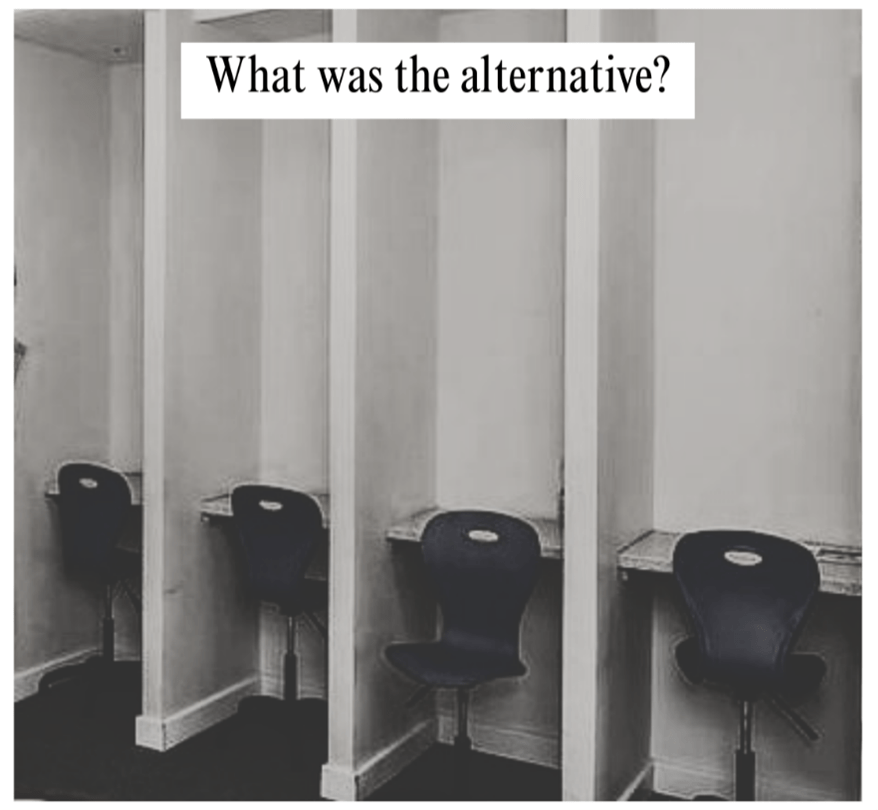
“[…] at the heart of the challenge is the matter of the reasonableness of the School’s having engineered an outcome in which the Claimants had spent anything up to a fifth, a quarter, or approaching a half, of an academic year removed from classroom teaching. And that is the core question with which the court is being asked to grapple. Doing so, however, demands confronting another core question: what was the alternative?”
THE HONOURABLE MRS JUSTICE COLLINS RICE DBE CB (R (EBB) v Gorse Academy Trust [2025], 114)
While sat in an Alternative Provision’s classroom with a focus group of 16–19-year-olds, I found myself attempting to answer the same question posed by Mrs Justice Collins Rice. After two years teaching in mainstream schools, I took on an MEd analysing behaviour policies and management, with a particular focus on how ‘consistent standards’ lead to further divisions of the student population that only allow success for the imagined ‘ideal pupil’. I was a quarter of the way through my research period, and after an impactful session the week before about participants’ experiences of educational institutions as segregated sites of violence, I was determined to hear what they believed would be the solution to the problems they had faced. Here they were, in a setting that did not use sanctions or rewards to manage behaviour, able to thrive where once they had struggled. If anyone had answers, surely it was them?
What I heard instead were the unmistakable sounds of hopelessness and cynicism, with solutions labelled as ‘Deux Ex Machina’ unlikely to succeed when translated from theory to practice. When asked why this was the case, one participant replied that:
“the people who have control over it, it’s not like that for them anymore, so they don’t need to care. There’s no investment there.” (“Rowan” from Wisken, 2025, Unpublished manuscript)
Looking back at my research diary and transcripts, I admit that I was (perhaps) overly optimistic in thinking my participants could solve all of education in two months of research – I am nothing, if not a dreamer! However, it was eye-opening to listen to these young people agree that change was impossible, not due to the mechanical demands, but because the adults in charge are not authentically committing themselves to creating necessary changes. I had spent months asking myself if I could rebuild trust between disenchanted students and mainstream education but had not thought to properly ask myself if mainstream education in its current form was worth trusting. If we want young people to place authentic trust in education, an alternative must be found that places all students as equally worthy of education. However, Collins Rice J’s question still looms over my head, a thundercloud waiting to strike with its demand for certainty. What is the alternative?
As much as it will frustrate many readers, I do not have a concrete solution. However, here is what I do know:
- The alternative must move away from enforcing a ‘complex of control’ in educators.
This “complex of control” (a phrase coined by one of my participants!) describes the view that control must always lie exclusively in the hands of the educator, with disruptive behaviour viewed as “attempts by pupils to take control” that must be challenged in order to “be in control at all times” (Chaplain, 2017). Through this mindset, the classroom becomes a warzone, with a constant battle of will stacked in favour of the educator. If we wish to transform education, we must move away from this model and towards one that values all the voices within the classroom. My participants acknowledged that “control is important for a teacher to have in a classroom, but it depends how that control’s expressed. There’s a difference between leading a discussion and being a military drill master” (“Rowan” from Wisken, 2025, Unpublished manuscript). For students to learn, we must ourselves learn how to create spaces where they are unconditionally welcomed.
- The foundations of an alternative must be built upon authentic student voice and experimentation.
To do this, students must be invited into the conversations we have about their educational experiences, and given “the opportunity to anticipate and experiment with the role changes“(Corbett and Wilson, 1995). Contrary to current models of student voice implemented within mainstream education, students must be invited to not only share their opinions in static moments of feedback, but to also experiment with alternative models of working, conceptualise the possible changes and critically evaluate pedagogy from the unique perspective they have. Facilitating this process would enable students to develop an authentically informed voice regarding the alternatives to their current modes of working, while simultaneously allowing educators to draw upon “the insights from [the students’] world [that] can help us to ‘see’ things that we do not normally pay attention to but that matter to them” (Rudduck & Flutter, 2003).
- The future must be paved in true empathy for both educator and student
In 1996, Nel Noddings wrote that “affect and emotion belong in the [teacher education] curriculum”, detailing how the use of stories in teacher training can be used to “dispel [the] belief” that educators must be unfeeling to be successful (Noddings, 1996). I posit that this logic can be expanded to include the stories of students within Initial Teacher Training and Early Career Teacher training programmes in order to share with new educators the impact they can have upon young people: for better or for worse. When you are single-handedly facing 20-30 young people, each with their own sense of autonomy and willpower, it can be difficult to remember every lesson you are taught in training. Let the one that sticks out the most be one of empathy and care, not control and dominance.
Currently, the attitude towards mainstream behaviour management is to assume the worst in every student’s behaviour (Chaplain, 2016; Department for Education, Feb. 2024). This permeates through the case ruling, as the anonymised students are identified as ‘struggling’ to meet behaviour standards and representing ‘work in progress’ in the eyes of the school. Mrs Justice Collins Rice does well to note that despite the case focusing on their behaviour, “these Claimants are developing adolescents with their whole adult lives ahead of them and reasons to be positive about their futures” (R (EBB) v Gorse Academy Trust [2025], 10). However, it is difficult to ascertain if, in the midst of the ‘destructive loop’ of repeated isolations Mr Squires KC outlined, these claimants have been given fair access to educational opportunities that will shape their possible futures (R (EBB) v Gorse Academy Trust [2025], 100). For the sake of these young people, I hope they can grow and thrive at school. However, the lack of legal duty does not mean we do not have a moral duty to do better for our students than sentence them to a life outside of the classroom. Our classes deserve better than acceptance of a system that only deems one type of student worthy of being in our classrooms. If we want true inclusion in education, we have a duty to start by inviting students to join the conversations we have about their experience in education — both in the classroom and in isolation.
References
Chaplain, R. (2017). Teaching without Disruption in the Secondary School: A Practical Approach to Managing Pupil Behaviour (2nd ed.). Routledge. https://doi.org/10.4324/9781315536781
Corbett, D., & Wilson, B. (1995). Make a Difference with, Not for, Students: A Plea to Researchers and Reformers. Educational Researcher, 24(5), 12–17. https://doi.org/10.2307/1177073
Department of Education (Feb. 2024). Behaviour in Schools: Advice for headteachers and school staff. https://assets.publishing.service.gov.uk/media/65ce3721e1bdec001a3221fe/Behaviour_in_schools_-_advice_for_headteachers_and_school_staff_Feb_2024.pdf
EBB & Ors, R (on the application of) v The Gorse Academies Trust [2025] EWHC 1983 (Admin), https://caselaw.nationalarchives.gov.uk/ewhc/admin/2025/1983 [Accessed 13th August 2025]
Rudduck, J. & Flutter, J. (2003) How to improve your school: giving pupils a voice (London and New York, Continuum Press).
Wisken, E. (2025).”Would Any Adult Be Accepting of All This?”: A YPAR Project Exploring Behaviour Management through the eyes of Students in Alternative Provision, [Unpublished]. University of Cambridge.
Biography
Elijah Wisken is a recent MEd student at the University of Cambridge, specialising in the transformation of behaviour policy and behaviour management to an approach led by empathy, communication and authentic relationships with students. He is especially interested in the intersectional ways in which behaviour policy can disenfranchise students in varied manners e.g. the impact of sanctions upon neurodiverse students. Outside of his research, Elijah is an English Teacher in an Alternative Provision in London, excitedly waiting to see what his students will share next. You can follow him on ResearchGate here: https://www.researchgate.net/profile/Elijah-Wisken?ev=prf_overview
 Cambridge Wellbeing & Inclusion SIG
Great post, Elijah, although slightly depressing that the young people felt there wasn’t a solution. You are right that we need to find a solution that involves structural change but what that might look like still needs much more discussion
LikeLike